
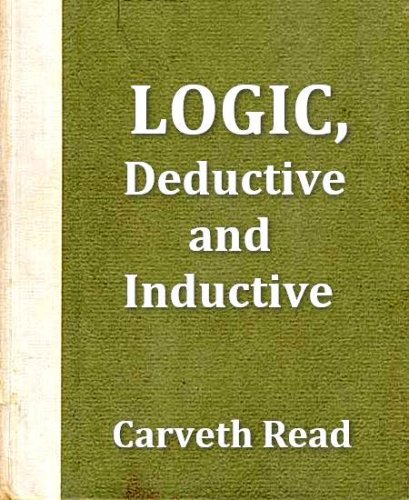
Logic: Deductive and Inductive
by Carveth Read
Publisher: Project Gutenberg 2006
ISBN/ASIN: B00264GNEA
Number of pages: 417
Description:
Logic is the science that explains what conditions must be fulfilled in order that a proposition may be proved, if it admits of proof. When propositions are expressed with the universality and definiteness that belong to scientific statements, they are called laws; and laws, so far as they are not laws of quantity, are tested by the principles of Logic, if they at all admit of proof.
Download or read it online for free here:
Download link
(multiple formats)
Similar books
 Formal Logic
- Wikibooks
An undergraduate college level textbook covering first order predicate logic with identity but omitting metalogical proofs. The first rules of formal logic were written over 2300 years ago by Aristotle and are still vital.
(14864 views)
 Symbolic Logic: A First Course
by Gary Hardegree - Mcgraw-Hill College
Contents: Basic Concepts of Logic; Truth-Functional Connectives; Validity in Sentential Logic; Translations in Sentential Logic; Derivations in Sentential Logic; Translations in Monadic Predicate Logic; Translations in Polyadic Predicate Logic; etc.
(17205 views)
 Logical Reasoning
by Bradley Dowden - California State University Sacramento
College level critical thinking textbook with solved exercises. Topics: Identifying claims, issues, arguments, and explanations. Ambiguity and vagueness. Information and fake news. Writing to convince others. Detecting fallacies. Inconsistency...
(5385 views)
 Logic, Inductive and Deductive
by William Minto - ManyBooks
In this little treatise two things are attempted that at first might appear incompatible. One of them is to put the study of logical formulae on a historical basis. The other aim is to increase the power of Logic as a practical discipline.
(10443 views)