
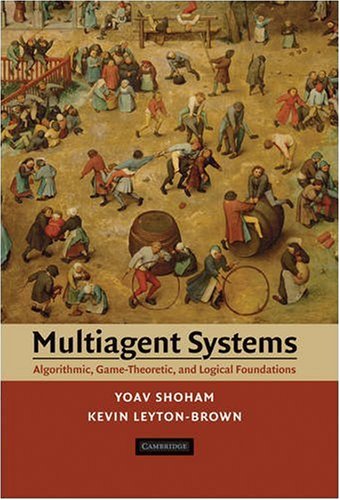
Multiagent Systems: Algorithmic, Game-Theoretic, and Logical Foundations
by Yoav Shoham, Kevin Leyton-Brown
Publisher: Cambridge University Press 2008
ISBN/ASIN: 0521899435
ISBN-13: 9780521899437
Number of pages: 532
Description:
Multiagent systems consist of multiple autonomous entities having different information and/or diverging interests. This comprehensive introduction to the field offers a computer science perspective, but also draws on ideas from game theory, economics, operations research, logic, philosophy and linguistics. It will serve as a reference for researchers in each of these fields, and be used as a text for advanced undergraduate and graduate courses.
Download or read it online for free here:
Download link
(3.7MB, PDF)
Similar books
 Encyclopedia of Computational Intelligence
by Eugene M. Izhikevich, at al. - Scholarpedia
Encyclopedia of Computational Intelligence covers neural networks, evolutionary computation, robotics, machine learning and pattern recognition, graphs and complexity, artificial intelligence, information theory, fuzzy systems, signal analysis, etc.
(15871 views)
 Artificial Intelligence and Responsive Optimization
by M. Khoshnevisan, S. Bhattacharya, F. Smarandache - Xiquan
The purpose of this book is to apply the Artificial Intelligence and control systems to different real models. The text is designed for graduate students and researchers who are active in the applications of AI and Control Systems in modeling.
(14262 views)
 Computers and Thought: A practical Introduction to Artificial Intelligence
by Mike Sharples, et al. - A Bradford Book
The aim of this book is to introduce people with little or no computing background to artificial intelligence (AI) and cognitive science. It emphasizes the psychological, social, and philosophical implications of artificial intelligence.
(10797 views)
 Artificial Intelligence - Agent Behaviour
by William John Teahan - BookBoon
This book adopts a behaviour-based approach to the design of agent-oriented systems. The topics covered from a behaviour-based perspective include agent communication, searching, knowledge and reasoning, and intelligence.
(14638 views)