
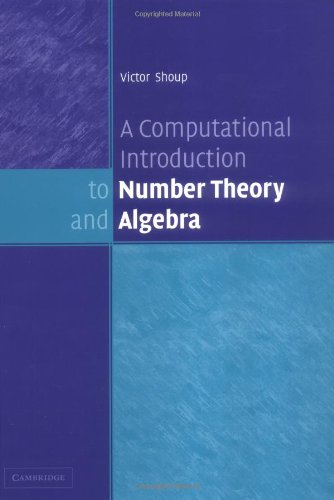
A Computational Introduction to Number Theory and Algebra
by Victor Shoup
Publisher: Cambridge University Press 2005
ISBN/ASIN: 0521851548
ISBN-13: 9780521851541
Number of pages: 534
Description:
Number theory and algebra play an increasingly significant role in computing and communications, as evidenced by the striking applications of these subjects to such fields as cryptography and coding theory. This introductory book emphasises algorithms and applications, such as cryptography and error correcting codes, and is accessible to a broad audience. The mathematical prerequisites are minimal: nothing beyond material in a typical undergraduate course in calculus is presumed, other than some experience in doing proofs - everything else is developed from scratch.
Download or read it online for free here:
Download link
(3.5MB, PDF)
Similar books
 Probabilistic Programming and Bayesian Methods for Hackers
by Cameron Davidson-Pilon - GitHub, Inc.
This book is designed as an introduction to Bayesian inference from a computational understanding-first, and mathematics-second, point of view. The book assumes no prior knowledge of Bayesian inference nor probabilistic programming.
(23419 views)
 An Architecture for Combinator Graph Reduction
by Philip J. Koopman, Jr. - Academic Press
The results of cache-simulation experiments with an abstract machine for reducing combinator graphs are presented. The abstract machine, called TIGRE, exhibits reduction rates that compare favorably with previously reported techniques.
(17836 views)
 Strange Attractors: Creating Patterns in Chaos
by Julien C. Sprott - M & T Books
Chaos and fractals have revolutionized our view of the world. This book shows examples of the artistic beauty that can arise from very simple equations, and teaches the reader how to produce an endless variety of such patterns.
(21597 views)
 Implementing Mathematics with The Nuprl Proof Development System
by R. L. Constable, at al. - Prentice Hall
The authors offer a tutorial on the new mathematical ideas which underlie their research. Many of the ideas in this book will be accessible to a well-trained undergraduate with a good background in mathematics and computer science.
(17709 views)