
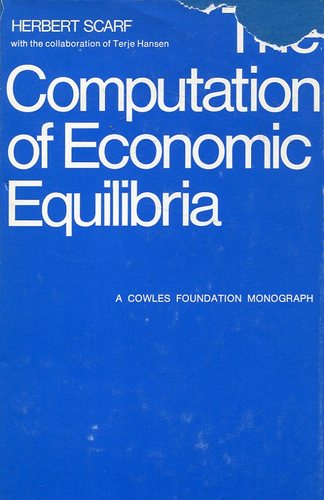
The Computation of Economic Equilibria
by Herbert Scarf
Publisher: Yale University Press 1973
ISBN/ASIN: 0300016409
ISBN-13: 9780300016406
Number of pages: 259
Description:
Contents: The Problem of Computing Equilibrium Prices; The Determination of an Approximate Fixed Point of a Continuous Mapping; Some Numerical Applications of Brouwer's Theorem; An Extension of the Algorithm; The Computation of Equilibria in a General Walrasian Model and Other Applications; A Procedure for Resolving Degeneracy; Algorithms Based on Simplicial Subdivisions; Some Applications to n-Person Game Theory.
Download or read it online for free here:
Download link
(5.4MB, PDF)
Similar books
 Analog Estimation Methods in Econometrics
by Charles F. Manski - Chapman and Hall
This book presents familiar elements of estimation theory from an analog perspective. It discusses recent developments in the theory of analog estimation and presents new results that offer flexibility in empirical research.
(10792 views)
 Production Economics: A Dual Approach to Theory and Applications
by Melvyn Fuss, Daniel L. McFadden - North-Holland
Chapters: Cost, Revenue, and Profit Functions; Symmetric Duality and Polar Production Functions; Applications of Profit Functions; General Linear Profit Function; Duality, Intermediate Inputs and Value-Added; Hick's Aggregation Theorem; etc.
(11754 views)
 Qualitative Choice Analysis: Theory, Econometrics, and an Application to Automobile Demand
by Kenneth Train - The MIT Press
This book is a comprehensive but concise text that covers the recently developed and widely applicable methods of qualitative choice analysis, illustrating the general theory through simulation models of automobile demand and use.
(11684 views)
 Econometrics
by Michael Creel - Universitat Autonoma de Barcelona
Textbook for graduate econometrics, it teaches ordinary least squares, maximum likelihood estimation, restrictions and hypothesis test, stochastic regressors, exogeneity and simultaneity, numeric optimization methods, method of moments, etc.
(21894 views)