
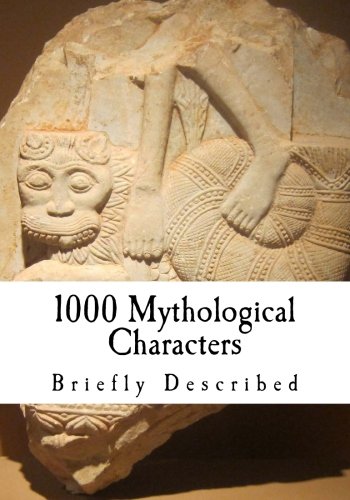
1000 Mythological Characters Briefly Described
by Edward Sylvester Ellis
Publisher: Hinds & Noble 1899
ISBN/ASIN: 1484070305
Number of pages: 146
Description:
Every people, no matter how degraded and sunken in barbarism, has some perception, some explanation of, and a more or less well-grounded belief in, a First Cause. Far back among the mists of antiquity, at the remotest beginnings of the shadowy centuries, sits enthroned a Being, who in His infinite might and power brought mankind, the universe, and all animate and inanimate things into existence, and who rewards those of His children who do His will, and punishes those who disobey His commands...
Download or read it online for free here:
Download link
(multiple formats)
Download mirrors:
Mirror 1
Similar books
 Maha-bharata: The Epic of Ancient India
by Romesh C. Dutt - Dent
Mahabharata relates to a great war in which all the warlike races of Northern India took a share, and may be compared to the Iliad. The vast mass of legends and poetry, accumulated during centuries, was cast in a narrative called the Maha-bharata.
(21555 views)
 Myths and Myth-Makers
by John Fiske
Old Tales and Superstitions Interpreted by Comparative Mythology. Contents: The Origins of Folk-Lore; Descent of Fire; Werewolves and Swan-Maidens; Light and Darkness; Myths of the Barbaric World; Juventus Mundi; The Primeval Ghost-World.
(10533 views)
 High History of the Holy Graal
- E. P. Dutton & co
According to Christian mythology, the Holy Grail was the dish, plate, or cup used by Jesus at the Last Supper, said to possess miraculous powers. This is the first volume of the Story of the Grail, compiled from a 16th-century copy of the original.
(14349 views)
 The Nibelungenlied
- University College, Toronto
There is probably no poem of German literature that has been so much studied and discussed, as the 'Nibelungenlied'. In its present form it is a product of the age of chivalry, but it reaches back to the earliest epochs of German antiquity.
(11850 views)