
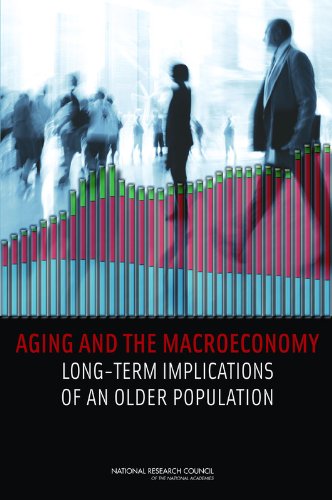
Aging and the Macroeconomy
Publisher: National Academies Press 2012
ISBN/ASIN: 0309261961
ISBN-13: 9780309261968
Number of pages: 256
Description:
This book presents the fundamental factors driving the ageing of the U.S. population, as well as its societal implications and likely long-term macroeconomic effects in a global context. It offers four practical approaches for preparing resources to support the future consumption of households and for adapting to the new economic landscape.
Download or read it online for free here:
Download link
(1.8MB, PDF)
Similar books
 Alternate Reality Games For Behavioral and Social Science Research
by Ruthanna Gordon - ETC Press
Alternate reality games may be able to fill gaps left by traditional studies in the behavioral and social sciences. This book examines the potential strengths of ARG-based social science research and the challenges that remain to be overcome ...
(6908 views)
 Wellbeing, Freedom and Social Justice: The Capability Approach Re-Examined
by Ingrid Robeyns - Open Book Publishers
How do we evaluate ambiguous concepts such as wellbeing, freedom, and social justice? The capability approach, a theoretical framework pioneered in the 1980s, has become an increasingly influential way to think about these issues.
(5473 views)
 An Introduction to the Human Development and Capability Approach
by Severine Deneulin, Lila Shahani - Earthscan Publications Ltd.
This book is essential reading for all those who wish to understand the Human Development and Capability approach to development. It both explains and advances thought on this important and increasingly influential perspective.
(11043 views)
 Elementary Fuzzy Matrix Theory and Fuzzy Models for Social Scientists
by W. B. Vasantha Kandasamy, at al. - arXiv
This book aims to assist social scientists to analyze their problems using fuzzy models. The basic and essential fuzzy matrix theory is given. The authors have only tried to give those essential basically needed to develop the fuzzy model.
(14628 views)