
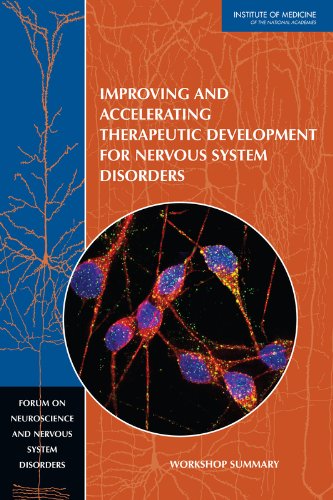
Improving and Accelerating Therapeutic Development for Nervous System Disorders
Publisher: National Academies Press 2013
ISBN/ASIN: 0309292468
ISBN-13: 9780309292467
Number of pages: 116
Description:
The aim was to examine opportunities to accelerate early phases of drug development for nervous system drug discovery. Workshop participants discussed challenges in neuroscience research for enabling faster entry of potential treatments into first-in-human trials, explored how new and emerging tools and technologies may improve the efficiency of research, and considered mechanisms to facilitate a more effective and efficient development pipeline.
Download or read it online for free here:
Download link
(1.2MB, PDF)
Similar books
 The Emerging Discipline of Quantitative Systems Pharmacology
by Tarek A Leil, Sergey Ermakov (eds) - Frontiers Media S.A.
Quantitative Systems Pharmacology is still in its infancy, but has tremendous potential to change the way we approach biomedical research. QSP is really the integration of two disciplines: 'Systems Biology' and 'Quantitative Pharmacology'.
(6486 views)
 Clinical Pharmacology in Health Care, Teaching and Research
- World Health Organization
Clinical Pharmacology is the scientific discipline that involves all aspects of the relationship between drugs and humans. It is a multidisciplinary science that encompasses professionals with a wide variety of scientific skills.
(12881 views)
 Application of Nanotechnology in Drug Delivery
by Ali Demir Sezer (ed.) - InTech
Since the advent of analytical techniques and capabilities to measure nanometer particles, there has been tremendous interest in the use of nanoparticles for drug delivery. This book collects reviews and original articles from eminent experts.
(7959 views)
 Pain Relief: From Analgesics to Alternative Therapies
by Cecilia Maldonado - InTech
This book comprises many aspects of pain treatment and the drugs involved in it. From old analgesics for pain alleviation to analgesics potential for diminishing oxidative stress; from pharmacological therapies to electrical ones ...
(7909 views)