
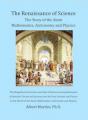
The Renaissance of Science: The Story of the Atom, Mathematics, Astronomy and Physics
by Albert Martini
Publisher: Project Gutenberg 2016
Number of pages: 561
Description:
This book presents the fundamental scientific developments in mathematics, physics and astronomy from the Classic Greek Era to the present time. It discusses and illustrates the 2,000-year history in the development of the great ideas, concepts and laws that revolutionized our scientific world. It also emphasizes how the new scientific concepts contributed to the logical development of the various sciences.
Download or read it online for free here:
Download link
(180MB, PDF)
Similar books
 Quantum Theory at the Crossroads
by Guido Bacciagaluppi, Antony Valentini - Cambridge University Press
1927 Solvay conference reconsidered. Contrary to folklore, the interpretation question was not settled at this conference and no consensus was reached; instead, a range of sharply conflicting views were presented and extensively discussed.
(12736 views)
 Lawrence and His Laboratory: A History of the Lawrence Berkeley Laboratory
by J. L. Heilbron, Robert W. Seidel - University of California Press
The Radiation Laboratory in Berkeley, California, was the birthplace of particle accelerators, radioisotopes, and modern big science. This volume is a saga of physics and finance in the Great Depression, when a new kind of science was born.
(13525 views)
 Preludes to Dark Energy: Zero-point energy and vacuum speculations
by Helge Kragh - arXiv
Although dark energy is a modern concept, some elements in it can be traced back to the early part of the twentieth century. This paper examines the origin of the idea of zero-point energy and in particular how it appeared in a cosmological context.
(8816 views)
 Eight Lectures on Theoretical Physics
by Max Planck - Columbia University Press
Landmark lectures (1909) by discoverer of quantum theory present revolutionary developments occasioned by application of quantum hypothesis to blackbody radiation. Also, how statistical mechanics transformed understanding of chemical physics.
(9807 views)