
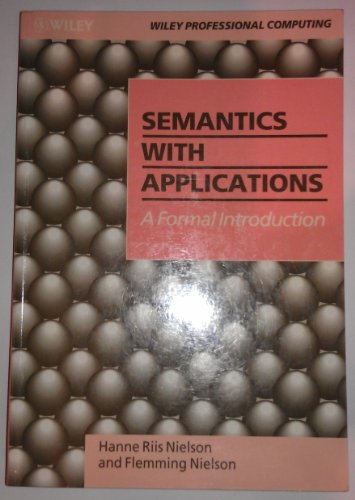
Semantics With Applications: A Formal Introduction
by Hanne Riis Nielson, Flemming Nielson
Publisher: John Wiley & Sons 1992
ISBN/ASIN: 0471929808
ISBN-13: 9780471929802
Number of pages: 250
Description:
The book covers the foundations of structural operational semantics (where computations consist of many small steps) and natural semantics (where computations consist of one big step). It shows how to describe the semantics of declarative as well as imperative language constructs and will also touch upon non-sequential constructs. It also presents proof principles for operational semantics and investigate the relationship between the two approaches to operational semantics. Problems from areas such as compiler construction, software validation, and program verication will be used to demonstrate the practical utility of semantics.
Download or read it online for free here:
Download link
(1.2MB, PDF)
Similar books
 Comparative Studies of Programming Languages
by Joey Paquet, Serguei A. Mokhov - arXiv
Lecture notes for the Comparative Studies of Programming Languages course. These notes include a compiled book of primarily related articles from the Wikipedia, as well as Comparative Programming Languages book and other resources.
(10289 views)
 Lectures on the Curry-Howard Isomorphism
by Morten Heine B. Sorensen, Pawel Urzyczyn - Elsevier Science
This book give an introduction to parts of proof theory and related aspects of type theory relevant for the Curry-Howard isomorphism. It can serve as an introduction to any or both of typed lambda-calculus and intuitionistic logic.
(11862 views)
 Programming Languages: Theory and Practice
by Robert Harper - Carnegie Mellon University
What follows is a working draft of a planned book that seeks to strike a careful balance between developing the theoretical foundations of programming languages and explaining the pragmatic issues involved in their design and implementation.
(11892 views)
 Programming Languages: Application and Interpretation
by Shriram Krishnamurthi - Lulu.com
The textbook for a programming languages course, taken primarily by advanced undergraduate and beginning graduate students. This book assumes that students have modest mathematical maturity, and are familiar with the existence of the Halting Problem.
(13060 views)