
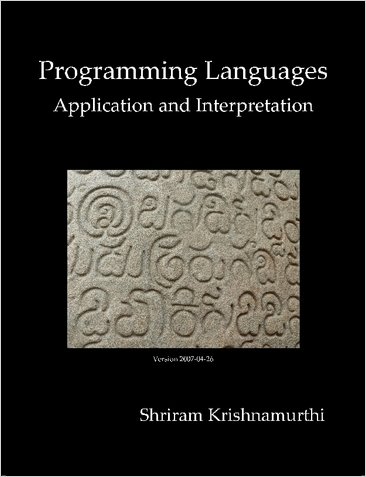
Programming Languages: Application and Interpretation
by Shriram Krishnamurthi
Publisher: Lulu.com 2007
ISBN/ASIN: B00262R7B0
Number of pages: 376
Description:
The book is the textbook for the programming languages course at Brown University, which is taken primarily by third and fourth year undergraduates and beginning graduate (both MS and PhD) students. It seems very accessible to smart second year students too, and indeed those are some of my most successful students. The book has been used at over a dozen other universities as a primary or secondary text. The book’s material is worth one undergraduate course worth of credit. The author wants to show students where languages come from, why we should regard languages as the ultimate form of abstraction, how to recognize such an evolving abstraction, and how to turn what they recognize into a language.
Download or read it online for free here:
Download link
(1.3MB, PDF)
Similar books
 Formal Language Theory for Natural Language Processing
by Shuly Wintner - ESSLLI
This text is a mild introduction to Formal Language Theory for students with little or no background in formal systems. The motivation is Natural Language Processing, and the presentation is geared towards NLP applications, with extensive examples.
(11068 views)
 Understanding Programming Languages
by Monti Ben-Ari - John Wiley & Sons
The book explains what alternatives are available to the language designer, how language constructs should be used for safety and readability, how language constructs are implemented, the role of language in expressing and enforcing abstractions.
(17195 views)
 Categories, Types, and Structures
by Andrea Asperti, Giuseppe Longo - MIT Press
Here is an introduction to category theory for the working computer scientist. It is a self-contained introduction to general category theory and the mathematical structures that constitute the theoretical background.
(19258 views)
 Formal Syntax and Semantics of Programming Languages
by Kenneth Slonneger, Barry L. Kurtz - Addison Wesley Longman
The book presents the typically difficult subject of formal methods in an informal, easy-to-follow manner. Readers with a basic grounding in discreet mathematics will be able to understand the practical applications of these difficult concepts.
(17113 views)