
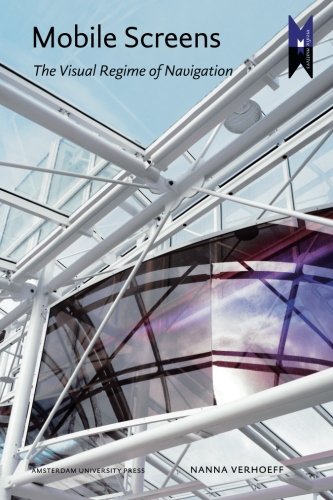
Mobile Screens: The Visual Regime of Navigation
by Nanna Verhoeff
Publisher: Amsterdam University Press 2012
ISBN/ASIN: 9089643796
ISBN-13: 9789089643797
Number of pages: 213
Description:
Nanna Verhoeff's new book is a must for anybody interested in visual culture and media theory. It offers a rich and stimulating theoretical account of the central dimension of our contemporary existence -- interfacing and navigating both data and physical world through a variety of screens (game consoles, mobile phones, car interfaces, GPS devices, etc.)
Download or read it online for free here:
Download link
(multiple PDF files)
Similar books
 Deep Mapping the Media City
by Shannon Mattern - University of Minnesota
Using techniques like excavation and mapping to discover the modern city's roots in time, Shannon Mattern advocates for urban media archaeology, a multisensory approach to investigating the material history of networked cities.
(4816 views)
 Digital Material: Tracing New Media in Everyday Life and Technology
by Marianne van den Boomen, et al. - Amsterdam University Press
The authors assembled their 'digital material' into an anthology, covering issues ranging from desktop metaphors to Web 2.0 ecosystems, from touch screens to blogging and e-learning, from role-playing games and cybergothic music to wireless dreams.
(6479 views)
 Imaging Identity
by Melinda Hinkson (ed.) - ANU Press
Imaging Identity presents potent reflections on the human condition through the prism of portraiture. These essays consider why portraits continue to have such galvanising appeal and perform fundamental work across so many social settings.
(4989 views)
 Rethinking the BBC: Public Media in the 21st Century
by Niki Seth-Smith (ed.) - Commonwealth Publishing
'Rethinking the BBC: Public Media in the 21st Century' brings together some of the most influential thinkers on media politics and policy in the UK and beyond. It is a vital contribution to the debate on public media at a moment of rapid change.
(5537 views)