
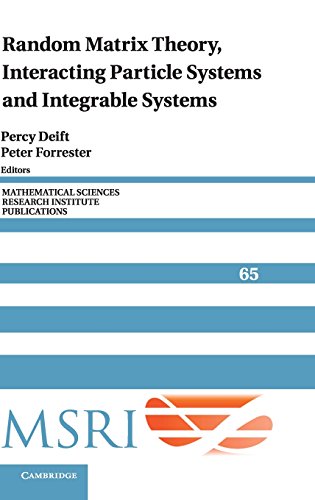
Random Matrix Theory, Interacting Particle Systems and Integrable Systems
by Percy Deift, Peter Forrester (eds)
Publisher: Cambridge University Press 2014
ISBN-13: 9781107079922
Number of pages: 528
Description:
Random matrix theory is at the intersection of linear algebra, probability theory and integrable systems, and has a wide range of applications in physics, engineering, multivariate statistics and beyond. The book contains review articles and research contributions on all these topics, in addition to other core aspects of random matrix theory such as integrability and free probability theory.
Download or read it online for free here:
Download link
(multiple PDF files)
Similar books
 Matrix Analysis
by Steven J Cox - Rice University
Matrix theory is a language for representing and analyzing multivariable systems. These notes will demonstrate the role of matrices in the modeling of physical systems and the power of matrix theory in the analysis and synthesis of such systems.
(10945 views)
 The Theory of Matrices
by C.C. MacDuffee - Chelsea
A concise overview of matrix algebra's many applications, discussing topics such as reviews of matrices, arrays, and determinants; the characteristic equation; associated integral matrices; equivalence, congruence, and similarity; etc.
(15336 views)
 Circulants
by Alun Wyn-jones
The goal of this book is to describe circulants in an algebraic context. It oscillates between the point of view of circulants as a commutative algebra, and the concrete point of view of circulants as matrices with emphasis on their determinants.
(15141 views)
 Determinants and Matrices
by R. Kochendörfer - Teubner
Basic methods and concepts are introduced. From the table of contents: Preliminaries; Determinants; Matrices; Vector spaces. Rank of a matrix; Linear Spaces; Hermitian/Quadratic forms; More about determinants and matrices; Similarity.
(14832 views)