
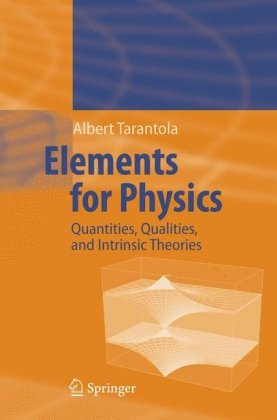
Elements for Physics: Quantities, Qualities, and Intrinsic Theories
by Albert Tarantola
Publisher: Springer 2006
ISBN/ASIN: 3540253025
ISBN-13: 9783540253020
Number of pages: 280
Description:
The book reviews and extends the theory of Lie groups, develops differential geometry, proposing compact definitions of torsion and of curvature, and adapts the usual notion of linear tangent application to the intrinsic point of view proposed for physics. As an illustration, two simple theories are studied with some detail, the theory of heat conduction and the theory of linear elastic media. The equations found differ quantitatively and qualitatively from those usually presented.
Download or read it online for free here:
Download link
(3.7MB, PDF)
Similar books
 Special Functions and Their Symmetries: Postgraduate Course in Applied Analysis
by Vadim Kuznetsov, Vladimir Kisil - University of Leeds
This text presents fundamentals of special functions theory and its applications in partial differential equations of mathematical physics. The course covers topics in harmonic, classical and functional analysis, and combinatorics.
(15690 views)
 Mathemathical Methods of Theoretical Physics
by Karl Svozil - Edition Funzl
This book presents the course material for mathemathical methods of theoretical physics intended for an undergraduate audience. The author most humbly presents his own version of what is important for standard courses of contemporary physics.
(11019 views)
 Floer Homology, Gauge Theory, and Low Dimensional Topology
by David Ellwood, at al. - American Mathematical Society
Mathematical gauge theory studies connections on principal bundles. The book provides an introduction to current research, covering material from Heegaard Floer homology, contact geometry, smooth four-manifold topology, and symplectic four-manifolds.
(13355 views)
 Topics in Spectral Theory
by Vojkan Jaksic - McGill University
The subject of these lecture notes is spectral theory of self-adjoint operators and some of its applications to mathematical physics. The main theme is the interplay between spectral theory of self-adjoint operators and classical harmonic analysis.
(9045 views)