
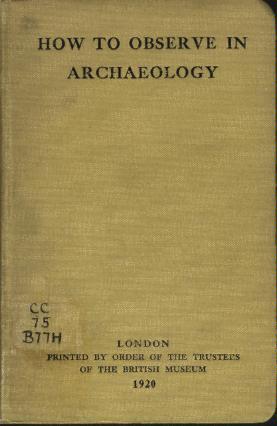
How to Observe in Archaeology
by F. G. Kenyon
Publisher: British Museum 1920
ISBN/ASIN: B001SLVBRQ
Number of pages: 102
Description:
This handbook is intended primarily for the use of travelers in the Near and Middle East who are interested in antiquities without being already trained archaeologists. Much knowledge is lost because it comes in the way of those who do not know how to profit by it or to record it. Accordingly, it has been thought that a handbook of elementary information and advice may be found of service by travelers with archaeological tastes; and the Trustees of the British Museum have undertaken the publication of it.
Download or read it online for free here:
Download link
(multiple formats)
Similar books
 Landscape Archaeology between Art and Science
by Sjoerd J. Kluiving, Erika Guttmann-Bond (eds) - Amsterdam University Press
This volume is focusing on the definition of landscape as used by processual archaeologists, earth scientists, and most historical geographers. It provides a rich foundation for discussion, and the papers in this collection cover a variety of topics.
(5755 views)
 Computational Approaches to the Study of Movement in Archaeology
by Silvia Polla, Philip Verhagen - De Gruyter Open Ltd
The archaeological study of movement and of its related patterns and features has been transformed by the use of GIS. Path analysis has become a very popular approach to the study of settlement and land-use dynamics in landscape archaeology.
(5347 views)
 The Archaeology of Sulawesi
by Sue O'Connor, David Bulbeck, Juliet Meyer - ANU Press
The central Indonesian island of Sulawesi has recently been hitting headlines with respect to its archaeology. It contains some of the oldest directly dated rock art in the world, and some of the oldest evidence for a hominin presence ...
(3962 views)
 Archaeology 2.0: New Approaches to Communication and Collaboration
by E. C. Kansa, S. W. Kansa, E. Watrall - eScholarship.org
How is the Web transforming the professional practice of archaeology? How can we best understand the possibilities of the Web in meeting the specialized needs of professionals? These are among the many questions posed and addressed in this book.
(8210 views)