
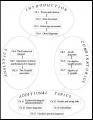
CDBooK: Introduction to Vassiliev Knot invariants
by S.Chmutov, S.Duzhin, J.Mostovoy
Publisher: Ohio State Universit 2009
Number of pages: 460
Description:
This text provides an introduction to the theory of finite type (Vassiliev) knot invariants, with a stress on its combinatorial aspects. It is intended for readers with no or little background in this area, and we care more about a clear explanation of the basic notions and constructions than about widening the exposition to more recent and more advanced material.
Download or read it online for free here:
Download link
(6.7MB, PDF)
Similar books
 Combinatorial Knot Theory
by Louis H. Kauffman - University of Illinois at Chicago
This book is an introduction to knot theory and to Witten's approach to knot theory via his functional integral. Contents: Topics in combinatorial knot theory; State Models and State Summations; Vassiliev Invariants and Witten's Functional Integral.
(10943 views)
 Geometry of Surfaces
by Nigel Hitchin
Geometry of Surfaces by Nigel Hitchin is a textbook on surfaces. However the author is also going to try and consider surfaces intrinsically, or abstractly, and not necessarily embedded in three-dimensional Euclidean space.
(14504 views)
 Algebraic and Geometric Surgery
by Andrew Ranicki - Oxford University Press
Surgery theory is the standard method for the classification of high-dimensional manifolds, where high means 5 or more. This book aims to be an entry point to surgery theory for a reader who already has some background in topology.
(10399 views)
 A Geometric Approach to Differential Forms
by David Bachman - arXiv
This is a textbook on differential forms. The primary target audience is sophomore level undergraduates enrolled in a course in vector calculus. Later chapters will be of interest to advanced undergraduate and beginning graduate students.
(15975 views)