
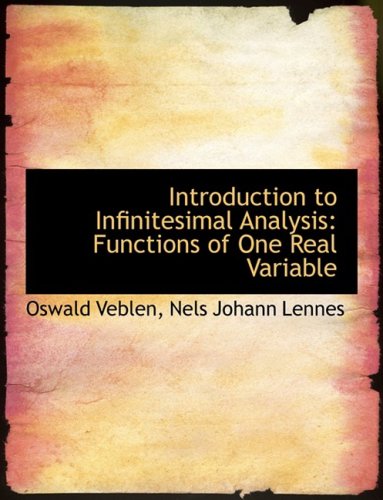
Introduction to Infinitesimal Analysis: Functions of One Real Variable
by N. J. Lennes
Publisher: John Wiley & Sons 1907
ISBN/ASIN: B001QAQX0Y
Number of pages: 225
Description:
This little volume is designed as a convenient reference book for a course dealing with the fundamental theorems of infinitesimal calculus in a rigorous manner. The book may also be used as a basis for a rather short theoretical course on real functions, such as is now given from time to time in some of our universities.
Download or read it online for free here:
Download link
(1.3MB, PDF)
Similar books
 Analysis Tools with Applications
by Bruce K. Driver - Springer
These are lecture notes from Real analysis and PDE: Basic Topological, Metric and Banach Space Notions; Riemann Integral and ODE; Lebesbgue Integration; Hilbert Spaces and Spectral Theory of Compact Operators; Complex Variable Theory; etc.
(17622 views)
 Set Theoretic Real Analysis
by Krzysztof Ciesielski - Heldermann Verlag
This text surveys the recent results that concern real functions whose statements involve the use of set theory. The choice of the topics follows the author's personal interest in the subject. Most of the results are left without the proofs.
(16012 views)
 How We Got From There to Here: A Story of Real Analysis
by Robert Rogers, Eugene Boman - Open SUNY Textbooks
This book covers the major topics typically addressed in an introductory undergraduate course in real analysis in their historical order. The book provides guidance for transforming an intuitive understanding into rigorous mathematical arguments.
(8238 views)
 A Primer of Real Analysis
by Dan Sloughter - Synechism.org
This is a short introduction to the fundamentals of real analysis. Although the prerequisites are few, the author is assuming that the reader has the level of mathematical maturity of one who has completed the standard sequence of calculus courses.
(7326 views)