
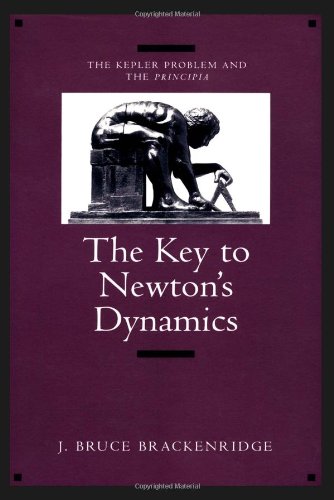
The Key to Newton's Dynamics
by J. Bruce Brackenridge
Publisher: University of California Press 1996
ISBN/ASIN: 0520202171
ISBN-13: 9780520202177
Number of pages: 330
Description:
The book clearly explains the surprisingly simple analytical structure that underlies the determination of the force necessary to maintain ideal planetary motion. J. Bruce Brackenridge sets the problem in historical and conceptual perspective, showing the physicist's debt to the works of both Descartes and Galileo. He tracks Newton's work on the Kepler problem from its early stages at Cambridge before 1669, through the revival of his interest ten years later, to its fruition in the first three sections of the first edition of the Principia.
Download or read it online for free here:
Read online
(online reading)
Similar books
 Classical Mechanics and Dynamical Systems
by Martin Scholtz - Charles University
Contents: Classical mechanics; Lagrange equations; Hamilton's equations; Variational principle; Hamilton-Jacobi equation; Electromagnetic field; Discrete dynamical systems and fractals; Dynamical systems; Bifurcations; Commands in Mathematica.
(6199 views)
 Applied Mechanics Dynamics
by G. W. Housner, D. E. Hudson - California Institute of Technology
Textbook for engineering students who wish to prepare for more advanced studies of dynamics. The emphasis is on particle and rigid-body dynamics. The book shows how the classical mechanics methods are applied to the various branches of engineering.
(19223 views)
 A Treatise on the Analytical Dynamics of Particles and Rigid Bodies
by E. T. Whittaker - Cambridge University Press
Analytical dynamics studies the motions of material bodies due to the mutual interactions with the aid of mathematical analysis. Here is a famous book on mathematical mechanics, a comprehensive account of the classical results of analytical dynamics.
(18340 views)
 Introduction to Statics and Dynamics
by Rudra Pratap, Andy Ruina - Cornell University
This is an engineering statics and dynamics text intended as both an introduction and as a reference. The book emphasizes use of vectors, free-body diagrams, momentum and energy balance and computation. Intuitive approaches are discussed throughout.
(20382 views)