
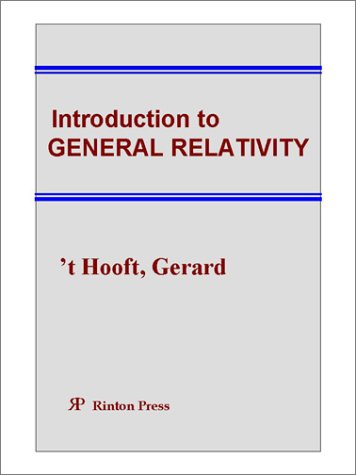
Introduction to General Relativity
by Gerard 't Hooft
Publisher: Rinton Press 2010
ISBN/ASIN: 1589490002
ISBN-13: 9781589490000
Number of pages: 69
Description:
This book presents, in a natural and beautiful way, the general relativity as a scheme for describing the gravitational field and the equations it obeys. Starting from physical motivations, curved coordinates are introduced, and then the notion of an affine connection field is added. At a later step, the metric field is added. One then sees clearly how space and time get more and more structure, until finally Einstein's field equations logically come out.
Download or read it online for free here:
Download link
(400KB, PDF)
Similar books
 Gravitational Waves, Sources, and Detectors
by Bernard F Schutz, Franco Ricci - arXiv
Notes of lectures for graduate students, covering the theory of linearized gravitational waves, their sources, and the prospects at the time for detecting gravitational waves. The lectures remain of interest for pedagogical reasons.
(9351 views)
 Lecture Notes on General Relativity
by Matthias Blau - Universitaet Bern
The first half of the book is dedicated to developing the machinery of tensor calculus and Riemannian geometry required to describe physics in a curved space time. We will then turn to various applications of General Relativity.
(13213 views)
 Spacetime and Fields
by Nikodem J. Poplawski - arXiv
A self-contained introduction to the classical theory of spacetime and fields. Topics: Spacetime (tensors, affine connection, curvature, metric, Lorentz group, spinors), Fields (principle of least action, action for gravitational field, matter, etc)
(10237 views)
 Metric Relativity and the Dynamical Bridge: highlights of Riemannian geometry in physics
by Mario Novello, Eduardo Bittencourt - arXiv
We present an overview of recent developments concerning modifications of the geometry of space-time to describe various physical processes of interactions among classical and quantum configurations. We concentrate in two main lines of research...
(5701 views)