
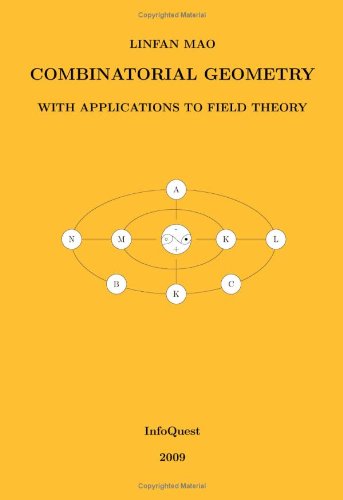
Combinatorial Geometry with Application to Field Theory
by Linfan Mao
Publisher: InfoQuest 2009
ISBN/ASIN: 1599731002
ISBN-13: 9781599731001
Number of pages: 499
Description:
This monograph is motivated with surveying mathematics and physics by CC conjecture, i.e., a mathematical science can be reconstructed from or made by combinatorialization. Topics covered in this book include fundamental of mathematical combinatorics, differential Smarandache n-manifolds, combinatorial or differentiable manifolds and submanifolds, Lie multi-groups, combinatorial principal fiber bundles, gravitational field, quantum fields with their combinatorial generalization, also with discussions on fundamental questions in epistemology.
Download or read it online for free here:
Download link
(2.9MB, PDF)
Similar books
 Introduction to Homological Geometry
by Martin A. Guest - arXiv
This is an introduction to some of the analytic aspects of quantum cohomology. The small quantum cohomology algebra, regarded as an example of a Frobenius manifold, is described without going into the technicalities of a rigorous definition.
(10463 views)
 Ricci Flow and the Poincare Conjecture
by John Morgan, Gang Tian - American Mathematical Society
This book provides full details of a complete proof of the Poincare Conjecture following Grigory Perelman's preprints. The book is suitable for all mathematicians from advanced graduate students to specialists in geometry and topology.
(13710 views)
 Transformations of Surfaces
by Luther Pfahler Eisenhart - Princeton University Press
Most of the transformations are reducible to transformations F or to transformations of the type such that a surface and a transform are focal surfaces of a W congruence. It is the purpose of this book to develop these two types of transformations.
(2588 views)
 Functional Differential Geometry
by Gerald Jay Sussman, Jack Wisdom - MIT
Differential geometry is deceptively simple. It is surprisingly easy to get the right answer with informal symbol manipulation. We use computer programs to communicate a precise understanding of the computations in differential geometry.
(11784 views)