
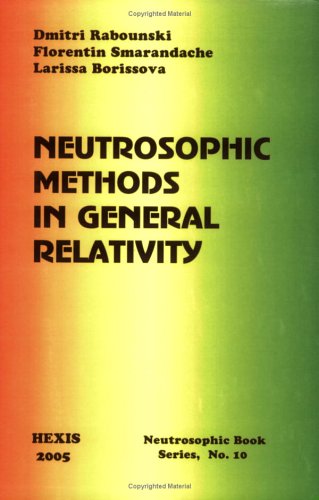
Neutrosophic Methods in General Relativity
by D. Rabounski, F. Smarandache, L. Borissova
Publisher: Hexis 2005
ISBN/ASIN: 1931233918
ISBN-13: 9781931233910
Number of pages: 80
Description:
Neutrosophy is a theory developed by Florentin Smarandache in 1995 as a generalization of dialectics, which studies the origin, nature and properties of neutralities. This book applies neutrosophic method to the General Theory of Relativity, aiming to discover new effects hidden before. Studying Einstein's basic space-time, neutrosophic method displays new trajectories and particles never considered before.
Download or read it online for free here:
Download link
(450KB, PDF)
Similar books
 Treatise on Differential Geometry and its role in Relativity Theory
by Subenoy Chakraborty - arXiv.org
These notes will be helpful to undergraduate and postgraduate students in theoretical physics and in applied mathematics. Modern terminology in differential geometry has been discussed in the book with the motivation of geometrical way of thinking.
(3113 views)
 The Confrontation between General Relativity and Experiment
by Clifford M. Will - arXiv
The status of experimental tests of general relativity and of theoretical frameworks for analyzing them are reviewed and updated. Tests of general relativity have reached high precision, including the light deflection, the Shapiro time delay, etc.
(7580 views)
 Complex Geometry of Nature and General Relativity
by Giampiero Esposito - arXiv
An attempt is made of giving a self-contained introduction to holomorphic ideas in general relativity, following work over the last thirty years by several authors. The main topics are complex manifolds, spinor and twistor methods, heaven spaces.
(16878 views)
 An Advanced Course in General Relativity
by Eric Poisson - University of Guelph
These lecture notes are suitable for a one-semester course at the graduate level. Table of contents: Fundamentals; Geodesic congruences; hypersurfaces; Lagrangian and Hamiltonian formulations of general relativity; Black holes.
(12544 views)