
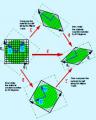
Functional and Structured Tensor Analysis for Engineers
by R. M. Brannon
Publisher: The University of Utah 2003
Number of pages: 323
Description:
A step-by-step introduction to tensor analysis that assumes you know nothing but basic calculus. Considerable emphasis is placed on a notation style that works well for applications in materials modeling, but other notation styles are also reviewed to help you better decipher the literature. Topics include: matrix and vector analysis, properties of tensors, dyads and outer products, axial vectors, axial tensors, scalar invariants and spectral analysis, geometry, material symmetry such as transverse isotropy, polar decomposition, and vector/tensor calculus theorems such as the divergence theorem and Stokes theorem.
Download or read it online for free here:
Download link
(3.6MB, PDF)
Similar books
 Extension Engineering
by Yang Chunyan, Cai Wen - Science Press
The book systematically elaborates the theoretical foundation, methodology and fields of application of extension engineering and presents application cases. The characteristics of the book lie in its combination of theory with practice.
(8051 views)
 Optimization Methods for Engineering Design
by A.R. Parkinson, R.J. Balling, J.D. Hedengren - Brigham Young University
In this text we discuss a computer-based approach to design optimization, to search for the best design according to criteria that we specify. Further, we employ sophisticated algorithms that enable the computer to efficiently search for the optimum.
(10241 views)
 Quantum Mechanics for Engineers
by Leon van Dommelen
This book was written for engineering graduate students who find themselves caught up in nano technology. The first part of the book provides a solid introduction to classical quantum mechanics, the second part discusses more advanced topics.
(23470 views)
 Past and Present Energy Societies
by Nina Möllers, Karin Zachmann - De Gruyter Open
Focussing on a range of energy types, this volume analyzes the social, cultural and political concepts of energy and their implementation and materialization within technical systems, applications, media representations and consumer practice.
(6096 views)