
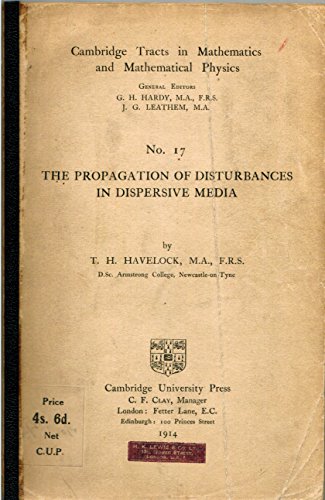
The Propagation Of Disturbances In Dispersive Media
by T.H. Havelock
Publisher: Cambridge University Press 1914
Number of pages: 107
Description:
From the table of contents: Simple groups and group velocity; The velocity of light; The Kelvin method for wave groups; Illustrations of group analysis; Action of a prism upon white light; The flow of energy; Propagation of wavefronts with discontinuities.
Download or read it online for free here:
Download link
(multiple formats)
Similar books
 Step-by-Step BS to PhD Math/Physics
by Alex Alaniz - UC Riverside
These are step-by-verifiable-step notes which are designed to help students with a year of calculus based physics who are about to enroll in ordinary differential equations go all the way to doctoral foundations in either mathematics or physics.
(14360 views)
 Mathematics for Physics: A Guided Tour for Graduate Students
by Michael Stone, Paul Goldbart - Cambridge University Press
This book provides a graduate-level introduction to the mathematics used in research in physics. It focuses on differential and integral equations, Fourier series, calculus of variations, differential geometry, topology and complex variables.
(18860 views)
 Euclidean Random Matrices and Their Applications in Physics
by A. Goetschy, S.E. Skipetrov - arXiv
We review the state of the art of the theory of Euclidean random matrices, focusing on the density of their eigenvalues. Both Hermitian and non-Hermitian matrices are considered and links with simpler random matrix ensembles are established.
(8214 views)
 LieART: A Mathematica Application for Lie Algebras and Representation Theory
by Robert Feger, Thomas W. Kephart - arXiv
We present the Mathematica application LieART (Lie Algebras and Representation Theory) for computations in Lie Algebras and representation theory, such as tensor product decomposition and subalgebra branching of irreducible representations.
(10424 views)