
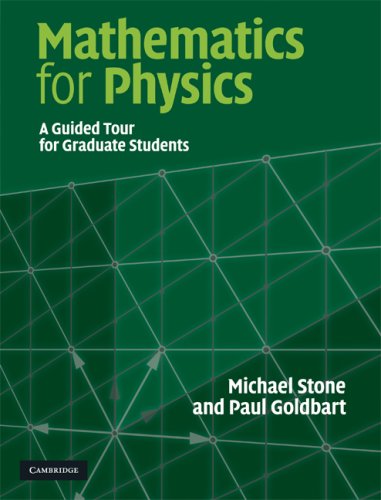
Mathematics for Physics: A Guided Tour for Graduate Students
by Michael Stone, Paul Goldbart
Publisher: Cambridge University Press 2009
ISBN/ASIN: 0521854032
Number of pages: 919
Description:
An engagingly-written account of mathematical tools and ideas, this book provides a graduate-level introduction to the mathematics used in research in physics. The first half of the book focuses on the traditional mathematical methods of physics - differential and integral equations, Fourier series and the calculus of variations. The second half contains an introduction to more advanced subjects, including differential geometry, topology and complex variables.
Download or read it online for free here:
Download link
(5.3MB, PDF)
Similar books
 Interactions, Strings and Isotopies in Higher Order Anisotropic Superspaces
by Sergiu I. Vacaru - arXiv
The monograph summarizes the author's results on the geometry of anholonomic and locally anisotropic interactions. The main subjects are in the theory of field interactions, strings and diffusion processes on spaces, superspaces and isospaces.
(11691 views)
 Lie Theory and Special Functions
by Willard Miller - Academic Press
The book studies the role played by special function theory in the formalism of mathematical physics. It demonstrates that special functions which arise in mathematical models are dictated by symmetry groups admitted by the models.
(14099 views)
 Quantum Spin Systems on Infinite Lattices
by Pieter Naaijkens - arXiv
These are the lecture notes for a one semester course at Leibniz University Hannover. The main aim of the course is to give an introduction to the mathematical methods used in describing discrete quantum systems consisting of infinitely many sites.
(7452 views)
 Partial Differential Equations of Mathematical Physics
by William W. Symes - Rice University
This course aims to make students aware of the physical origins of the main partial differential equations of classical mathematical physics, including the equations of fluid and solid mechanics, thermodynamics, and classical electrodynamics.
(15993 views)