
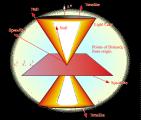
Introduction to Differential Geometry and General Relativity
by Stefan Waner
2005
Number of pages: 138
Description:
From the table of contents: distance, open sets, parametric surfaces and smooth functions, smooth manifolds and scalar fields, tangent vectors and the tangent space, contravariant and covariant vector fields, tensor fields, Riemannian manifolds, locally Minkowskian manifolds, covariant differentiation, geodesics and local inertial frames, the Riemann curvature tensor, comoving frames and proper time, the stress tensor and the relativistic stress-energy tensor, three basic premises of general relativity, the Einstein field equations and derivation of Newton's law, the Schwarzschild metric and event horizons, White Dwarfs, neutron stars and black holes.
Download or read it online for free here:
Download link
(1.7MB, PDF)
Similar books
 Introduction to General Relativity
by Gerard 't Hooft - Rinton Press
The book presents the general relativity as a scheme for describing the gravitational field and the equations it obeys. Starting from physical motivations, curved coordinates are introduced, and then the notion of an affine connection field is added.
(14647 views)
 Complex Geometry of Nature and General Relativity
by Giampiero Esposito - arXiv
An attempt is made of giving a self-contained introduction to holomorphic ideas in general relativity, following work over the last thirty years by several authors. The main topics are complex manifolds, spinor and twistor methods, heaven spaces.
(16877 views)
 The Mathematical Theory of Relativity
by Arthur Stanley Eddington - Cambridge University Press
Sir Arthur Eddington here formulates mathematically his conception of the world of physics derived from the theory of relativity. The argument is developed in a form which throws light on the origin and significance of the great laws of physics.
(6024 views)
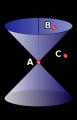 General Covariance and the Foundations of General Relativity
by John D Norton - University of Pittsburgh
This text reviews the development of Einstein's thought on general covariance (the fundamental physical principle of GTR), its relation to the foundations of general relativity and the evolution of the continuing debate over his viewpoint.
(10168 views)