
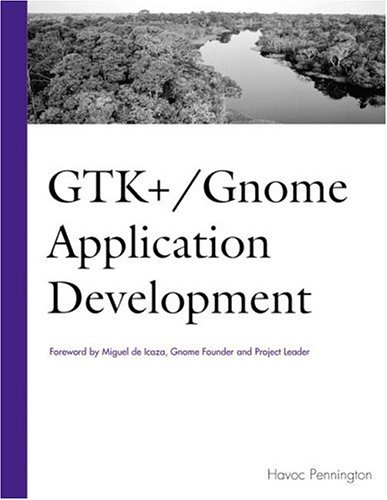
GTK+/Gnome Application Development
by Havoc Pennington
Publisher: Sams 1999
ISBN/ASIN: 0735700788
ISBN-13: 9780735700789
Number of pages: 414
Description:
This title is for the reader who is conversant with the C programming language and UNIX/Linux development. It provides detailed and solution-oriented information designed to meet the needs of programmers and application developers using the GTK+/Gnome libraries. Coverage complements existing GTK+/Gnome documentation, going into more depth on pivotal issues such as uncovering the GTK+ object system, working with the event loop, managing the Gdk substrate, writing custom widgets, and mstering GnomeCanvas.
Download or read it online for free here:
Download link
(2.7MB, PDF)
Similar books
 C Programming in Linux
by David Haskins - BookBoon
Using a series of web development examples, this book will give you an interesting glimpse into a powerful lower-level world. C is tight and spare and economical, and people who know C will ensure critical systems keep running.
(22638 views)
 Linux Appliance Design
by Bob Smith, et al. - No Starch Press
The book shows how to use librta to build a Linux appliance. Topics include appliance architecture, security, and how to build simple, yet responsive user interfaces. The book shows how to build different user interfaces including a web interface.
(5909 views)
 KDE 2.0 Development
by David Sweet - Sams
Topics include: KDE UI Compliance, Style Reference, The Qt Toolkit, Responsive User Interface, Complex-Function KDE Widgets, Multimedia, DCOP, KParts, Creating Documentation, Packaging Code, CVS and CVSUP, and KDevelop: the IDE for KDE.
(10151 views)
 Linux Systems Programming
by Jonathan Macey - Bournemouth Media School
Contents: Command Line Arguments; Environment Variables; The Standard I/O Library; Executing Processes as a Stream; Showing system Processes; Creating processes in a program; Processes and Threads; Inter-process Communication; Semaphores; etc.
(13177 views)