
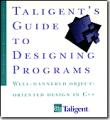
Taligent's Guide to Designing Programs
Publisher: Taligent Press 1994
ISBN/ASIN: 0201408880
ISBN-13: 9780201408881
Number of pages: 152
Description:
Well-Mannered object-oriented design in C++: this is a brief overview of object-oriented program design, focusing on operating-system development. The text will be of interest to the developers working with Taligent, as well as other C++ programmers who are interested in a quick summary of good OOP techniques.
Download or read it online for free here:
Read online
(online html)
Similar books
 No Bugs!: Delivering Error-Free Code in C and C++
by David Thielen - Addison-Wesley
The book offers a revolutionary approach to software development by showing how to write error-free code from the start. Presented are techniques to stop many kinds of bugs from being included in a program. It also discusses how to test programs.
(28116 views)
 The Ultimate Question of Programming, Refactoring, and Everything
by Andrey Karpov
In this article you will find 42 recommendations about coding in C++ that can help a programmer avoid a lot of errors, save time and effort. Every recommendation is given with a practical example, which proves the currentness of this question.
(7298 views)
 How to think like a Computer Scientist (C++ Version)
by Allen B. Downey
This book teaches you to think like a computer scientist - to combine the best features of mathematics, natural science, and engineering, to use formal languages to denote ideas, to observe the behavior of complex systems, form hypotheses, etc.
(25436 views)
 An Introduction to GCC
by Brian J. Gough, Richard M. Stallman - Network Theory Ltd
This manual provides a complete introduction to the GNU C and C++ compilers, common problems and encountered error messages, with numerous easy examples. The text covers compiling using headers and libraries, preprocessor, linking, and more.
(30118 views)