
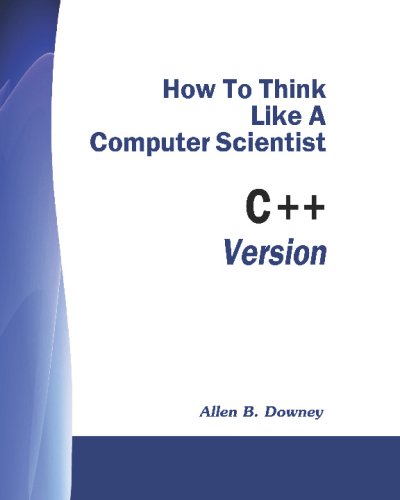
How to think like a Computer Scientist (C++ Version)
by Allen B. Downey
1999
ISBN/ASIN: 1441419055
Number of pages: 189
Description:
The goal of this book is to teach you to think like a computer scientist. I like the way computer scientists think because they combine some of the best features of Mathematics, Engineering, and Natural Science. Like mathematicians, computer scientist use formal languages to denote ideas (specifically compuations). Like engineers, they design things, assembling components into systems and evaluating tradeoffs among alternatives. Like scientists, they observe the behavior of complex systems, form hypotheses, and test predictions.
Download or read it online for free here:
Download link
(800KB, PDF)
Similar books
 Language Translation Using PCCTS and C++
by Terence John Parr - Automata Publishing Company
This book is a reference guide for the parser generator ANTLR, ANother Tool for Language Recognition, and the tree-parser generator SORCERER, which is suited to source-to-source translation. It is valuable to scientists, engineers, or programmers.
(17600 views)
 Taligent's Guide to Designing Programs
- Taligent Press
Well-Mannered object-oriented design in C++: this is a brief overview of object-oriented program design, focusing on operating-system development. The text will be of interest to the C++ programmers who need a quick summary of good OOP techniques.
(21356 views)
 Financial Numerical Recipes in C++
by Bernt Arne Ødegaard
Useful examples and algorithms for people working within the field of finance. Typical examples are option/derivatives pricing, term structure calculations, mean variance analysis. The author made C++ subroutines that implements common algorithms.
(26567 views)
 An Introduction to GCC
by Brian J. Gough, Richard M. Stallman - Network Theory Ltd
This manual provides a complete introduction to the GNU C and C++ compilers, common problems and encountered error messages, with numerous easy examples. The text covers compiling using headers and libraries, preprocessor, linking, and more.
(30118 views)