
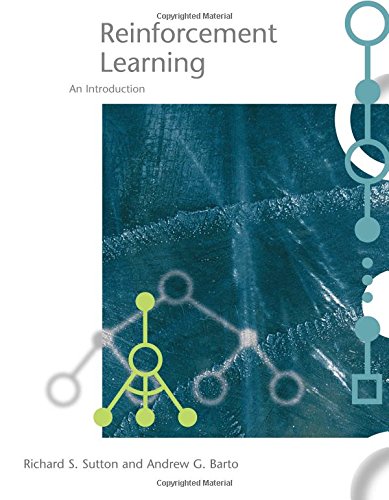
Reinforcement Learning: An Introduction
by Richard S. Sutton, Andrew G. Barto
Publisher: The MIT Press 2017
ISBN/ASIN: 0262193981
ISBN-13: 9780262193986
Number of pages: 445
Description:
Reinforcement learning is a computational approach to learning whereby an agent tries to maximize the total amount of reward it receives when interacting with a complex, uncertain environment. In this book, Richard Sutton and Andrew Barto provide a clear and simple account of the key ideas and algorithms of reinforcement learning. Their discussion ranges from the history of the field's intellectual foundations to the most recent developments and applications. The only necessary mathematical background is familiarity with elementary concepts of probability.
Download or read it online for free here:
Download link
(12MB, PDF)
Similar books
 Boosting: Foundations and Algorithms
by Robert E. Schapire, Yoav Freund - The MIT Press
Boosting is an approach to machine learning based on the idea of creating a highly accurate predictor by combining many weak and inaccurate 'rules of thumb'. A remarkably rich theory has evolved around boosting, with connections to a range of topics.
(6748 views)
 Modeling Agents with Probabilistic Programs
by Owain Evans, et al. - AgentModels.org
This book describes and implements models of rational agents for (PO)MDPs and Reinforcement Learning. One motivation is to create richer models of human planning, which capture human biases. The book assumes basic programming experience.
(5972 views)
 Introduction to Machine Learning for the Sciences
by Titus Neupert, et al. - arXiv.org
This is an introductory machine learning course specifically developed with STEM students in mind, written by the theoretical Condensed Matter Theory group at the University of Zurich. We discuss supervised, unsupervised, and reinforcement learning.
(3312 views)
 Introduction to Machine Learning
by Alex Smola, S.V.N. Vishwanathan - Cambridge University Press
Over the past two decades Machine Learning has become one of the mainstays of information technology and a rather central part of our life. Smart data analysis will become even more pervasive as a necessary ingredient for technological progress.
(9979 views)