
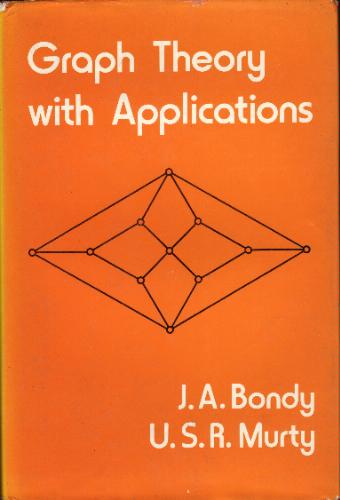
Graph Theory With Applications
by J.A. Bondy and U.S.R. Murty
Publisher: Elsevier Science Ltd 1976
ISBN/ASIN: 0444194517
ISBN-13: 9780444194510
Number of pages: 270
Description:
The primary aim of this book is to present a coherent introduction to graph theory, suitable as a textbook for advanced undergraduate and beginning graduate students in mathematics and computer science. It provides a systematic treatment of the theory of graphs without sacrificing its intuitive and aesthetic appeal. Commonly used proof techniques are described and illustrated, and a wealth of exercises - of varying levels of difficulty - are provided to help the reader master the techniques and reinforce their grasp of the material.
Download or read it online for free here:
Download link
(23MB, PDF)
Download mirrors:
Mirror 1
Similar books
 Graph Theory
by Reinhard Diestel - Springer
Textbook on graph theory that covers the basics, matching, connectivity, planar graphs, colouring, flows, substructures in sparse graphs, Ramsey theory for graphs, hamiltonian cycles, random graphs, minors, trees, and WQO.
(20130 views)
 Advanced Graph Theory and Combinatorial Optimization
by Alexander Schrijver
From the table of contents: Shortest trees and branchings; Matchings and covers; Edge-colouring; Multicommodity flows and disjoint paths; Matroids; Perfect matchings in regular bipartite graphs; Minimum circulation of railway stock.
(11312 views)
 Digraphs: Theory, Algorithms and Applications
by Jorgen Bang-Jensen, Gregory Gutin - Springer
Digraphs presents a comprehensive survey of the study of directed graphs. It covers theoretical aspects with detailed proofs, and some algorithms and applications. The essential textbook and reference for graduate students and researchers.
(17904 views)
 Algorithmic Graph Theory
by David Joyner, Minh Van Nguyen, Nathann Cohen - Google Code
An introductory book on algorithmic graph theory. Theory and algorithms are illustrated using the Sage open source software. The text covers graph algorithms, trees and forests, distance and connectivity, optimal graph traversals, planar graphs, etc.
(15803 views)