
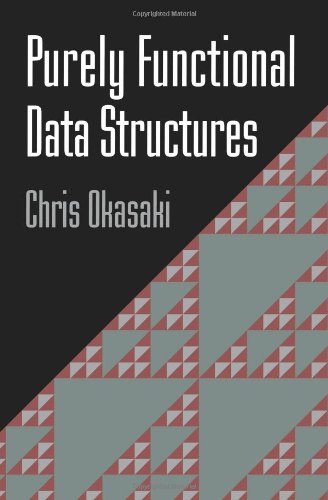
Purely Functional Data Structures
by Chris Okasaki
Publisher: Carnegie Mellon University 1996
ISBN/ASIN: 0521663504
Number of pages: 162
Description:
This book describes data structures from the point of view of functional languages, with examples, and presents design techniques that allow programmers to develop their own functional data structures. The author includes both classical data structures, such as red-black trees and binomial queues, and a host of new data structures developed exclusively for functional languages.
Download or read it online for free here:
Download link
(620KB, PDF)
Similar books
 Average Case Analysis of Algorithms on Sequences
by Wojciech Szpankowski - Wiley-Interscience
A book on a topic that has witnessed a surge of interest over the last decade, owing in part to several novel applications in data compression and computational molecular biology. It describes methods employed in average case analysis of algorithms.
(11993 views)
 Algorithms and Data Structures
by Niklaus Wirth - Prentice Hall
The book treats practically important algorithms and data structures. It starts with a chapter on data structure, then it treats sorting algorithms, concentrates on several examples of recursion, and deals with dynamic data structures.
(21012 views)
 Data Structures and Algorithm Analysis in C++
by Clifford A. Shaffer - Dover Publications
A comprehensive treatment focusing on efficient data structures and algorithms, this text explains how to select or design the data structure best suited to specific problems. It uses C++ programming language and is suitable for second-year courses.
(23525 views)
 Knapsack Problems: Algorithms and Computer Implementations
by Silvano Martello, Paolo Toth - John Wiley & Sons
The book on exact and approximate algorithms for a number of important problems in the field of integer linear programming, which the authors refer to as 'knapsack'. Includes knapsack problems such as binary, bounded, unbounded or binary multiple.
(17780 views)