
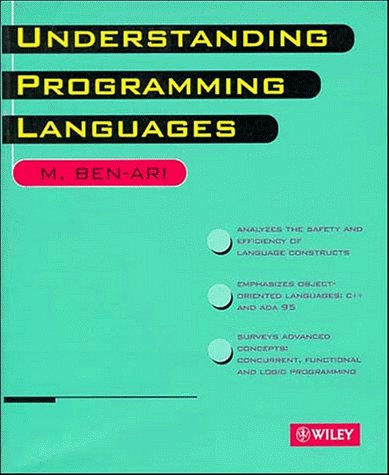
Understanding Programming Languages
by Monti Ben-Ari
Publisher: John Wiley & Sons 1996
ISBN/ASIN: 0471958468
ISBN-13: 9780471958468
Number of pages: 322
Description:
Understanding Programming Languages explains what alternatives are available to the language designer, how language constructs should be used for safety and readability, how language constructs are implemented, the role of language in expressing and enforcing abstractions.
The book compares constructs from C with constructs from Ada in terms of levels of abstraction. Studying these languages provides a firm foundation for an extensive examination of object-oriented language support in C++ and Ada 95. The final chapters introduce functional (ML) and logic (Prolog) programming languages to demonstrate that imperative languages are not conceptual necessities for programming.
Download or read it online for free here:
Download link
(0.8MB, PDF)
Similar books
 Compositional Semantics
by Gary Hardegree - UMass Amherst
Contents: Basic Categorial Syntax; Shortcomings of Standard Categorial Syntax; Expanded Categorial Syntax; Examples of Expanded Categorial Syntax; Categorial Logic; Basic Categorial Semantics; Lambda-Abstraction; Expanded Categorial Semantics; etc.
(16296 views)
 Categories, Types, and Structures
by Andrea Asperti, Giuseppe Longo - MIT Press
Here is an introduction to category theory for the working computer scientist. It is a self-contained introduction to general category theory and the mathematical structures that constitute the theoretical background.
(19255 views)
 Formal Language Theory for Natural Language Processing
by Shuly Wintner - ESSLLI
This text is a mild introduction to Formal Language Theory for students with little or no background in formal systems. The motivation is Natural Language Processing, and the presentation is geared towards NLP applications, with extensive examples.
(11067 views)
 Let Over Lambda: 50 Years of Lisp
by Doug Hoyte - Lulu.com
One of the most hardcore computer programming books out there. Starting with the fundamentals, it describes the most advanced features of the most advanced language: Common Lisp. This book is about macros, that is programs that write programs.
(22746 views)