
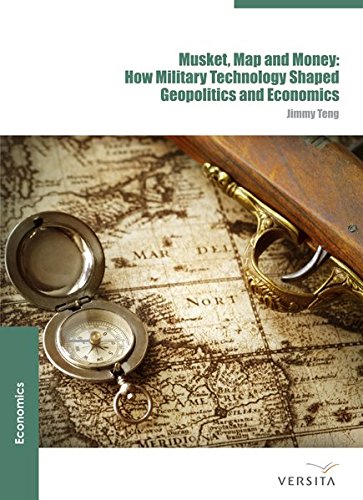
Musket, Map and Money
by Jimmy Teng
Publisher: De Gruyter Open 2014
ISBN-13: 9788376560595
Number of pages: 196
Description:
Military technological changes decisively shaped geopolitics and the fortunes of states, empires and civilizations. In his book Jimmy Teng claims that to understand the impacts of these military technological changes is in fact to understand the causes behind the following major historical puzzles or important facts: the leading position of the Near East during the dawn of civilization; the splendid achievements of Greece, India and China during the axial era; the classical golden age of India under the Gupta Empire; etc.
Download or read it online for free here:
Download link
(multiple PDF files)
Similar books
 The Pure Theory of Capital
by Friedrich A. Hayek - Ludwig von Mises Institute
The greatest failing of non-Austrians theories of macroeconomics is that they lack a robust theory of capital. F.A. Hayek sought to fill out the theory of the business cycle with an impenetrable one, and the result was this remarkable 1941 treatise.
(16053 views)
 Pillars of Prosperity: Free Markets, Honest Money, Private Property
by Ron Paul - Mises Institute
This economic manifesto by Ron Paul collects his greatest speeches and debates. He provided a coherent explanation of everything the government has done wrong in this area. He also provides a way out: free market, honest money, and private property.
(14115 views)
 The Economy as a Complex Spatial System
- Springer Open
Visualizing the EU as a complex and multi-layered network, this collected volume is organized in three parts, each of them dealing with a different level of analysis: the macro-level, the meso-level, and the micro-level ...
(8359 views)
 Principles of Economics
by Libby Rittenberg, Timothy Tregarthen - University of Minnesota
The authors teach economics as the study of 'choice' by providing students with an accessible, straightforward overview of economics. Rittenberg and Tregarthen help students to understand how real individuals actually work with economics.
(30309 views)