
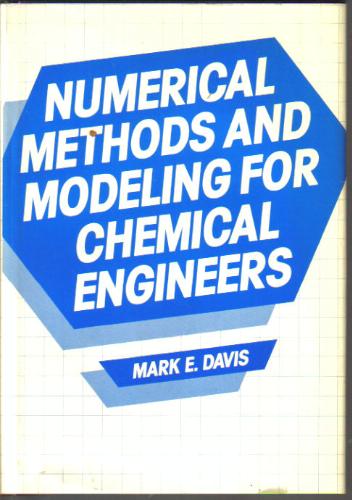
Numerical Methods and Modeling for Chemical Engineers
by Mark E. Davis
Publisher: John Wiley & Sons 1984
ISBN/ASIN: 0471887617
ISBN-13: 9780471887614
Number of pages: 267
Description:
This book is an introduction to the quantitative treatment of differential equations that arise from modeling physical phenomena in the area of chemical engineering. It evolved from a set of notes developed for courses taught at Virginia Polytechnic Institute and State University. Although the subjects covered in this book are the same as in other texts, the treatment is different in that it emphasizes the methods implemented in commercial software. The aim is to provide an understanding of how the subroutines work in order to help the engineer gain maximum benefit from them.
Download or read it online for free here:
Download link
(7.7MB, PDF)
Similar books
 Advancing Desalination
by Robert Y. Ning - InTech
The purpose of desalination is to make water drinkable, or pure enough for industrial applications. This volume touches on Membranes and Systems, Solar Desalination, Reverse Osmosis Process Chemistry and Control, Drinking Water Quality, etc.
(12646 views)
 Elements of X-Ray Diffraction
by B.D. Cullity - Addison-Wesley
Intended to acquaint the reader with the theory of x-ray diffraction, the experimental methods involved, and the main applications. It stresses X-ray diffraction rather than metallurgy. Designed for beginners, not a reference for the advanced reader.
(28210 views)
 Chemical Engineering Vocabulary
by Maximilian Lackner - Bookboon
The Chemical Engineering Vocabulary was written for students and young professionals in chemistry, mechanical engineering, chemical engineering and economics, who have to do with chemical engineering in an academic or industrial setting.
(9987 views)
 Fundamentals of Reaction Engineering - Examples
by Rafael Kandiyoti - BookBoon
This is the 'Worked Examples' part of the book entitled 'Fundamentals of Reaction Engineering', an introductory text covering the basic elements of reactor design. The focus is on revising the main concepts in the form of problems and their answers.
(15703 views)