
Spherical Astronomy
by F. Brünnow
Publisher: Van Nostrand 1865
ISBN/ASIN: B002KW46KG
Number of pages: 559
Description:
The celestial sphere and its diurnal motion; On the changes of the fundamental planes to which the places of the stars are referred; Corrections of the observations arising from the position of the observer on the surface of the Earth and from certain properties of light; On the method by which the places of the stars and the values of the constant quantities necessary for their reduction are determined by observations; Determination of the position of the fixed great circles of the celestial sphere with respect to the horizon of a place; On the determination of the dimensions of the Earth and the horizontal parallaxes of the heavenly bodies; Theory of the astronomical instruments.
Download or read it online for free here:
Download link
(multiple formats)
Similar books
 Gravitational Wave Detection by Interferometry
by Matthew Pitkin, Stuart Reid, Sheila Rowan, Jim Hough - arXiv
The main theme of this review is a discussion of the mechanical and optical principles used in the various long baseline systems in operation around the world - LIGO, Virgo, TAMA300, LCGT, GEO600 - and in LISA, a proposed space-borne interferometer.
(9276 views)
 Elementary Mathematical Astronomy
by C. Barlow, G. Bryan - University Correspondence College Press
The book fills the gap between the many excellent popular and non-mathematical works on Astronomy, and the standard treatises on the subject, which involve high mathematics. The rudimentary knowledge of Geometry, Algebra, and Trigonometry is assumed.
(13647 views)
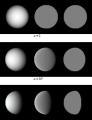 Planetary Photometry
by Max Fairbairn
The text covers principles of planetary photometry: radiance and the equation of transfer, diffuse reflection and transmission, albedo, scattering and absorption, net flux and exitance, and a brief history of the Lommel-Seeliger law.
(12196 views)
 Practical Astronomy
by P. S. Michie, F. S. Harlow - John Wiley & Sons
This volume is designed especially for the use of the cadets of the U. S. Military Academy, as a supplement to the course in General Astronomy. It is therefore limited to that branch of Practical Astronomy which relates to Field Work.
(10353 views)