
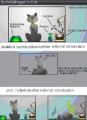
The basic paradoxes of statistical classical physics and quantum mechanics
by Oleg Kupervasser
Publisher: arXiv 2009
Number of pages: 180
Description:
The statistical classical mechanics and the quantum mechanics are two developed and well-known theories. Nevertheless, they contain a number of paradoxes. It forces many scientists to doubt internal consistency of these theories. However the given paradoxes can be resolved within the framework of the existing physics, without introduction of new laws.
Download or read it online for free here:
Download link
(2.4MB, PDF)
Similar books
 Selected Topics in Applications of Quantum Mechanics
by Mohammad Reza Pahlavani (ed.) - InTech
This book covers some of the applications of quantum mechanics in nuclear physics, medical science, information technology, atomic physics and material science, as well as selected topics of quantum mechanics through different bases and ideas ...
(8849 views)
 Quantum mechanics: An intermediate level course
by Richard Fitzpatrick - Lulu.com
Lecture notes for an upper-division quantum mechanics course: fundamental concepts, one-dimensional potentials, central potentials, angular momentum, the hydrogen atom, time-independent perturbation theory, time-dependent perturbation theory, etc.
(17088 views)
 The Cellular Automaton Interpretation of Quantum Mechanics
by Gerard 't Hooft - Springer
This book presents the deterministic view of quantum mechanics developed by Gerard 't Hooft. 't Hooft has revived the old hidden variable ideas, but now in a much more systematic way. Quantum mechanics is viewed as a tool rather than a theory.
(6221 views)
 Understanding Quantum Measurement from the Solution of Dynamical Models
by A.E. Allahverdyan, R. Balian, T.M. Nieuwenhuizen - arXiv
The quantum measurement problem: why a unique outcome is obtained in each individual experiment, is currently tackled by solving models. After an introduction, we review the models proposed. A flexible and realistic quantum model is introduced...
(8940 views)