
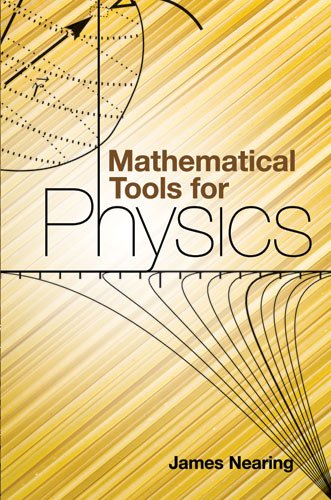
Mathematical Tools for Physics
by James Nearing
Publisher: Dover Publications 2010
ISBN/ASIN: 048648212X
ISBN-13: 9780486482125
Number of pages: 569
Description:
I intend this for the undergraduate level, providing a one-semester bridge between some of the introductory math courses and the physics courses in which we expect to use the mathematics. This is the course typically called Mathematical Methods in Physics. The text itself has been expanded so that it now contains far more than a one semester course.
Download or read it online for free here:
Download link
(3.8MB, PDF)
Similar books
 Street-Fighting Mathematics
by Sanjoy Mahajan - The MIT Press
The book about the art of guessing results and solving problems without doing a proof or an exact calculation. Techniques include extreme-cases reasoning, dimensional analysis, successive approximation, discretization, generalization, etc.
(20668 views)
 Handbook of Mathematics for Engineers
by E. V. Huntington, L. A. Fischer - McGraw Hill
The Handbook contains, in compact form, accurate statements of those facts and formulas of mathematics which are likely to be useful to the worker in applied mathematics. It is thought to be more comprehensive than any other similar work in English.
(26819 views)
 A Mathematics Primer for Physics Graduate Students
by Andrew E. Blechman
The author summarizes most of the more advanced mathematical trickery seen in electrodynamics and quantum mechanics in simple and friendly terms with examples. Mathematical tools such as tensors or differential forms are covered in this text.
(24865 views)
 Inverse Problem Theory and Methods for Model Parameter Estimation
by Albert Tarantola - SIAM
The first part deals with discrete inverse problems with a finite number of parameters, while the second part deals with general inverse problems. The book for scientists and applied mathematicians facing the interpretation of experimental data.
(17721 views)