
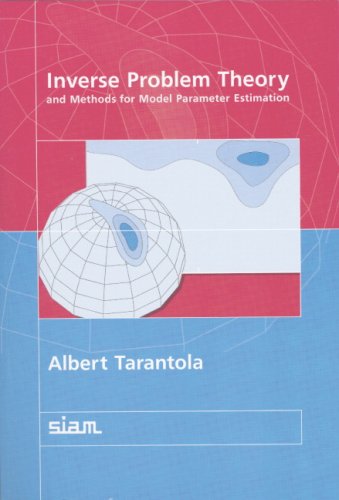
Inverse Problem Theory and Methods for Model Parameter Estimation
by Albert Tarantola
Publisher: SIAM 2004
ISBN/ASIN: 0898715725
ISBN-13: 9780898715729
Number of pages: 358
Description:
The first part of the book deals exclusively with discrete inverse problems with a finite number of parameters, while the second part of the book deals with general inverse problems. The book is directed to all scientists, including applied mathematicians, facing the problem of quantitative interpretation of experimental data in fields such as physics, chemistry, biology, image processing, and information sciences. Considerable effort has been made so that this book can serve either as a reference manual for researchers or as a textbook in a course for undergraduate or graduate students.
Download or read it online for free here:
Read online
(online preview)
Similar books
 Markov Chains and Mixing Times
by D. A. Levin, Y. Peres, E. L. Wilmer - American Mathematical Society
An introduction to the modern approach to the theory of Markov chains. The main goal of this approach is to determine the rate of convergence of a Markov chain to the stationary distribution as a function of the size and geometry of the state space.
(14925 views)
 Lectures on Stochastic Analysis
by Thomas G. Kurtz - University of Wisconsin
Covered topics: stochastic integrals with respect to general semimartingales, stochastic differential equations based on these integrals, integration with respect to Poisson measures, stochastic differential equations for general Markov processes.
(14689 views)
 Probability, Statistics and Stochastic Processes
by Cosma Rohilla Shalizi
Contents: Probability (Probability Calculus, Random Variables, Discrete and Continuous Distributions); Statistics (Handling of Data, Sampling, Estimation, Hypothesis Testing); Stochastic Processes (Markov Processes, Continuous-Time Processes).
(12424 views)
 Design of Comparative Experiments
by R. A. Bailey - Cambridge University Press
This book develops a coherent framework for thinking about factors that affect experiments and their relationships, including the use of Hasse diagrams. The book is ideal for advanced undergraduate and beginning graduate courses.
(23808 views)