
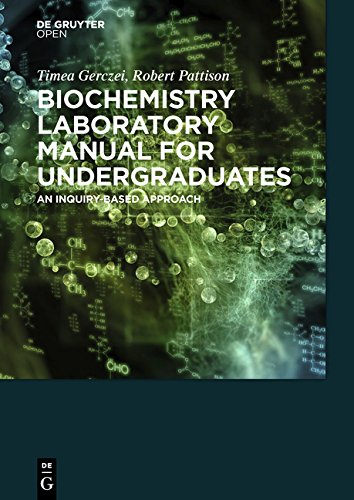
Biochemistry Laboratory Manual For Undergraduates
by Timea Gerczei, Scott Pattison
Publisher: Walter De Gruyter Inc 2014
ISBN/ASIN: 3110411326
Number of pages: 174
Description:
Biochemistry Laboratory Manual for undergraduates is the first textbook on the market that uses a highly relevant model, antibiotic resistance, to teach seminal topics of biochemistry and molecular biology. Inclusion of a research project does not entail a limitation: this manual includes all classic biochemistry techniques such as HPLC or enzyme kinetics and is complete with numerous problem sets relating to each topic.
Download or read it online for free here:
Download link
(multiple formats)
Similar books
 The Photosynthesis of Carbon Compounds
by Melvin Calvin, James Alan Bassham - W.A. Benjamin
In this book we review the evidence leading to the formulation of the carbon reduction cycle and discuss its quantitative importance. We describe as far as possible the biosynthetic pathways which we believe exist in the chloroplast.
(11315 views)
 Enzyme Inhibitors and Activators
by Murat Senturk (ed.) - InTech
This book is focusing on the research area of enzyme inhibitor and activator, enzyme-catalyzed biotransformation, usage of microbial enzymes, enzymes associated with programmed cell death, natural products as potential enzyme inhibitors, etc.
(8898 views)
 Enzyme Technology
by Martin F. Chaplin, Christopher Bucke - Cambridge University Press
This textbook provides an authoritative guide to the principles and practice of the utilization of enzymes in biotechnology. Enzymes have increasingly important applications in the food and pharmaceutical industry, in medicine, and as biosensors.
(21112 views)
 Bioinorganic Chemistry
by Bertini, Gray, Lippard, Valentine - University Science Books
This book covers material of a course in bioinorganic chemistry for graduate and advanced undergraduate students in chemistry or biochemistry. It should provide students with the background required to follow the research literature in the field.
(23509 views)