
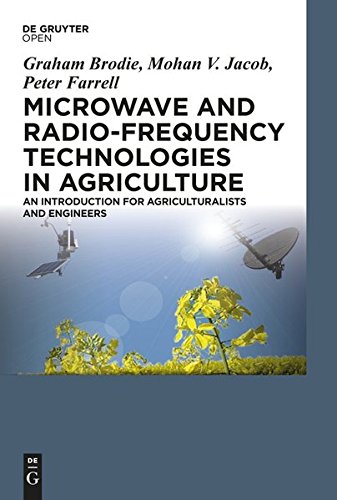
Microwave and Radio-Frequency Technologies in Agriculture
by G. Brodie, M. V. Jacob, P. Farrell
Publisher: De Gruyter Open 2015
ISBN-13: 9783110455403
Number of pages: 369
Description:
The main purpose of the book is to provide a glimpse of what is possible and encourage practitioners in the engineering and agricultural industries to explore how radio-frequency and microwave systems might further enhance the agricultural industry. The authors have extensive experience in agricultural and microwave engineering, instrumentation and communication systems.
Download or read it online for free here:
Download link
(multiple PDF files)
Similar books
 Soilless Culture: Use of Substrates for the Production of Quality Horticultural Crops
by Md. Asaduzzaman (ed.) - InTech
This volume provides useful information on the techniques of growing horticultural crops using either inert organic or inorganic substrates and also on use of substrates consisting locally available and inexpensive materials with adequate properties.
(11733 views)
 Cotton Physiology
by Jack R. Mauney, James McD. Stewart (eds) - Cotton Foundation
From virtually every aspect, cotton is one of the most interesting higher organisms in the plant kingdom. It is rather unique in that it produces both fiber and food. Compared with most crop plants, cotton adapts quite well to adverse conditions.
(8961 views)
 Plants and Environment
by Hemanth KN. Vasanthaiah, Devaiah Kambiranda - InTech
The main intention of this publication is to provide a state-of-the-art and up-to-date knowledge of recent developments in understanding of plant responses to major abiotic stresses, limitations and the current status of crop improvement.
(13081 views)
 Hydroculture
- Wikibooks
This book demonstrates the fundamentals and advanced topics of hydroculture gardening including: aquaponics, hydroponics, aquascaping, aeroponics, passive-hydroponics, hydroculture related gardening, root zone basics, plant nutrition fundamentals.
(11795 views)