
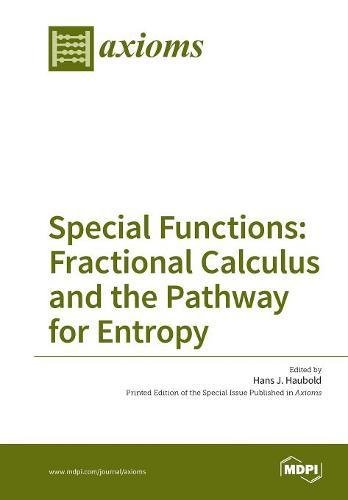
Special Functions: Fractional Calculus and the Pathway for Entropy
by Hans J. Haubold (ed.)
Publisher: MDPI AG 2018
ISBN-13: 9783038426653
Number of pages: 306
Description:
Historically, the notion of entropy emerged in conceptually very distinct contexts. This book deals with the connection between entropy, probability, and fractional dynamics as they appeared, for example, in solar neutrino astrophysics since the 1970's.
Download or read it online for free here:
Download link
(24MB, PDF)
Similar books
 Cosmic Rays and the Search for a Lorentz Invariance Violation
by Wolfgang Bietenholz - arXiv
This is an introductory review about the on-going search for a signal of Lorentz Invariance Violation (LIV) in cosmic rays. The author first summarizes basic aspects of cosmic rays, focusing on rays of ultra high energy (UHECRs).
(16514 views)
 Black-Hole Phenomenology
by Neven Bilic - arXiv
This set of lectures is an introduction to black-hole astrophysics. The emphasis is made on the phenomenology of X-ray binaries and of supermassive compact objects at galactic centers. Notes to the lectures given at the School on Particle Physics...
(9494 views)
 Introduction to Dark Matter Experiments
by R. W. Schnee - arXiv.org
This is a set of lectures presented at the Theoretical Advanced Study Institute 2009. I provide an introduction to experiments designed to detect WIMP dark matter directly, focusing on building intuitive understanding of the potential WIMP signals.
(11419 views)
 Black Holes
by P.K. Townsend - arXiv
Notes for a course taught in part III of the Cambridge University Mathematical Tripos: gravitational collapse, Schwarzschild black hole, charged black holes; rotating black holes; energy and angular momentum; black hole mechanics; Hawking radiation.
(17739 views)