
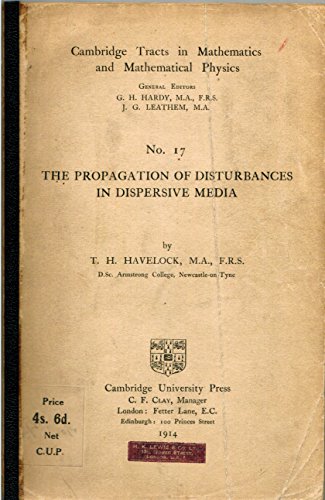
The Propagation Of Disturbances In Dispersive Media
by T.H. Havelock
Publisher: Cambridge University Press 1914
Number of pages: 107
Description:
From the table of contents: Simple groups and group velocity; The velocity of light; The Kelvin method for wave groups; Illustrations of group analysis; Action of a prism upon white light; The flow of energy; Propagation of wavefronts with discontinuities.
Download or read it online for free here:
Download link
(multiple formats)
Similar books
 Elements for Physics: Quantities, Qualities, and Intrinsic Theories
by Albert Tarantola - Springer
Reviews Lie groups, differential geometry, and adapts the usual notion of linear tangent application to the intrinsic point of view proposed for physics. The theory of heat conduction and the theory of linear elastic media are studied in detail.
(16232 views)
 Topics in Spectral Theory
by Vojkan Jaksic - McGill University
The subject of these lecture notes is spectral theory of self-adjoint operators and some of its applications to mathematical physics. The main theme is the interplay between spectral theory of self-adjoint operators and classical harmonic analysis.
(9045 views)
 Applications of global analysis in mathematical physics
by Jerrold E. Marsden - Publish or Perish, inc
The book introduces some methods of global analysis which are useful in various problems of mathematical physics. The author wants to make use of ideas from geometry to shed light on problems in analysis which arise in mathematical physics.
(16194 views)
 Mirror Symmetry
by Cumrun Vafa, Eric Zaslow - American Mathematical Society
The book provides an introduction to the field of mirror symmetry from both a mathematical and physical perspective. After covering the relevant background material, the monograph is devoted to the proof of mirror symmetry from various viewpoints.
(13733 views)