
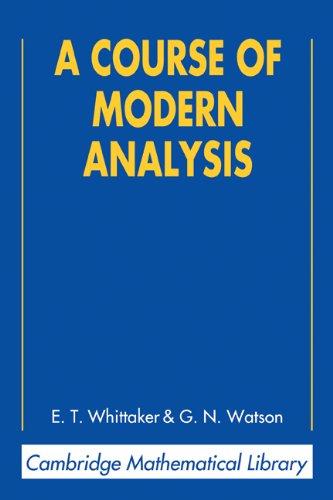
A Course of Modern Analysis
by E. T. Whittaker, G. N. Watson
Publisher: Cambridge University Press 1920
Number of pages: 608
Description:
This classic text has entered and held the field as the standard book on the applications of analysis to the transcendental functions. The authors explain the methods of modern analysis in the first part of the book and then proceed to a detailed discussion of the transcendental function, unhampered by the necessity of continually proving new theorems for special applications. In this way the authors have succeeded in being rigorous without imposing on the reader the mass of detail that so often tends to make a rigorous demonstration tedious. Researchers and students will find this book as valuable as ever.
Download or read it online for free here:
Download link
(multiple formats)
Similar books
 Bernoulli Polynomials and Applications
by Omran Kouba - arXiv
In these notes we try to familiarize the audience with the theory of Bernoulli polynomials; we study their properties, and we give, with proofs and references, some of the most relevant results related to them. Several applications are presented.
(8372 views)
 Introduction to Analysis
by Ray Mayer - Reed College
Contents: Notation, Undefined Concepts, Examples; Fields; Induction and Integers; Complexification of a Field; Real Numbers; Complex Numbers; Complex Sequences; Continuity; Properties of Continuous Functions; Derivative; Infinite Series; etc.
(7847 views)
 Elementary Mathematical Analysis
by J.W. Young, F.M. Morgan - The Macmillan Company
The book presents a course suitable for students in the first year of our colleges, universities, and technical schools. It presupposes on the part of the student only the usual minimum entrance requirements in elementary algebra and plane geometry.
(12046 views)
 Multivector Differential Calculus
by Eckhard Hitzer - arXiv
This paper treats the fundamentals of the multivector differential calculus part of geometric calculus. The multivector differential is introduced, followed by the multivector derivative and the adjoint of multivector functions.
(11151 views)