
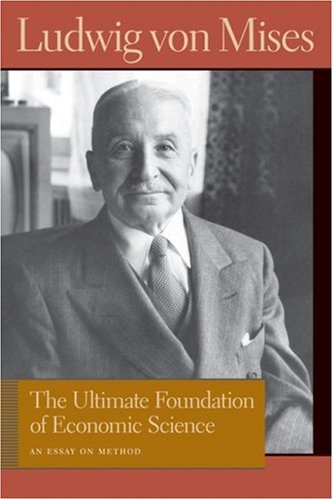
The Ultimate Foundation of Economic Science
by Ludwig von Mises
Publisher: Liberty Fund Inc. 2006
ISBN/ASIN: 0865976392
ISBN-13: 9780865976399
Number of pages: 158
Description:
In this volume, Mises argued that economics is a science because human action is a natural order of life and that it is the actions of humans that determine markets and capital decisions. Since Mises believed these links could be proven scientifically, he concluded that economics, with its basis on that human action, is indeed a science in its own right and not an ideology or a metaphysical doctrine. What has been described as his most passionate work, "The Ultimate Foundation of Economic Science" brings together all of the themes from Mises's previous work.
Download or read it online for free here:
Download link
(11MB, PDF)
Similar books
 Capital as Power: A Study of Order and Creorder
by Jonathan Nitzan, Shimshon Bichler - Routledge
The authors address the old theoretical conundrum in political economy -- the theory of capital -- with a view to supplying a more satisfactory answer to the question 'what is capital?' The work fits into the tradition of radical political economy.
(13305 views)
 The Economics and Ethics of Private Property
by Hans-Hermann Hoppe - Ludwig von Mises Institute
'Do not steal' is the first principle of sound economic systems. The topics covered by Hoppe are wide ranging: employment, interest, money, banking, trade cycles, taxes, public goods, war, imperialism, and the rise and fall of civilizations.
(16283 views)
 Modeling Bounded Rationality
by Ariel Rubinstein - The MIT Press
The author considers the modeling of choice, the modeling of procedural rationality, knowledge, memory, the choice of what to know, and group decisions. The second part discusses the fundamental difficulties of modeling bounded rationality in games.
(14244 views)
 Economics and Language
by Ariel Rubinstein - Cambridge University Press
Five essays investigating both the economics of language and the language of economics. The author touches on the structure of binary relations in daily language, the evolutionary development of the meaning of words, and more.
(18274 views)