
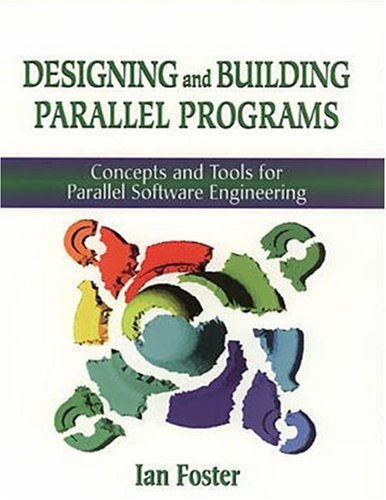
Designing and Building Parallel Programs
by Ian Foster
Publisher: Addison Wesley 1995
ISBN/ASIN: 0201575949
ISBN-13: 9780201575941
Number of pages: 430
Description:
Designing and Building Parallel Programs is a book for students and professionals who need to know how to write parallel programs. It is neither a programming language manual nor an academic treatise on algorithms. Instead, it approaches parallel programming as an engineering activity, in which programs are developed in a methodical fashion and both cost and performance are considered at each stage in a design. It is intended as both an introduction to parallel programming and a practitioner's guide for programmers, engineers, and scientists developing programs for parallel and distributed computer systems.
Download or read it online for free here:
Read online
(online html)
Similar books
 A Framework for Enabling Distributed Applications on the Internet
by Mark Anthony McLaughlin - arXiv
Internet distributed applications (IDAs) are internet applications with which many users interact simultaneously. In this paper the author provides a basis for a framework that combines IDAs collectively within a single context.
(8675 views)
 How to Write Parallel Programs: A First Course
by Nicholas Carriero, David Gelernter - MIT Press
In the near future every programmer will need to understand parallelism, a powerful way to run programs fast. The authors of this straightforward tutorial provide the instruction that will transform ordinary programmers into parallel programmers.
(9625 views)
 An introduction to one-way quantum computing in distributed architectures
by Earl T. Campbell, Joseph Fitzsimons - arXiv
This review provides a gentle introduction to one-way quantum computing in distributed architectures. One-way quantum computation shows significant promise as a model for distributed systems, particularly probabilistic entangling operations.
(9538 views)
 Is Parallel Programming Hard, And, If So, What Can You Do About It?
by Paul E. McKenney
The purpose of this book is to help you understand how to program shared-memory parallel machines. By describing the algorithms that have worked well in the past, we hope to help you avoid some of the pitfalls that have beset parallel projects.
(13714 views)