
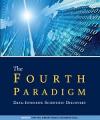
The Fourth Paradigm: Data-Intensive Scientific Discovery
by Tony Hey, Stewart Tansley, Kristin Tolle
Publisher: Microsoft Research 2009
ISBN-13: 9780982544204
Number of pages: 287
Description:
Increasingly, scientific breakthroughs will be powered by advanced computing capabilities that help researchers manipulate and explore massive datasets. This collection of essays expands on the vision of pioneering computer scientist Jim Gray for a new, fourth paradigm of discovery based on data-intensive science and offers insights into how it can be fully realized.
Download or read it online for free here:
Download link
(6.3MB, PDF)
Similar books
 Science and Hypothesis
by Henri Poincare - W. Scott
Henri Poincare wrote the essays in this book in 1905, the landmark period in physics after Maxwell and before special relativity. Not just the science, but the social attitudes of the day come through in this pleasant little book.
(11866 views)
 On Being a Scientist: responsible conduct in research
- National Academies Press
A well-written resource for understanding the principles of responsible research. This is an excellent guide, not only for seasoned scientists and research administrators, but also for newcomers to the field of science and research administration.
(14685 views)
 On the Dual Uses of Science and Ethics
by Brian Rappert, Michael J. Selgelid (eds) - ANU Press
Claims about the transformations enabled by modern science and medicine have been accompanied by an unsettling question in recent years: might the knowledge being produced undermine -- rather than further -- human and animal well being?
(6800 views)
 Yorick's World: Science and the Knowing Subject
by Peter Caws - University of California Press
Peter Caws provides a fresh treatment of some of the most vexing problems in the philosophy of science: explanation, induction, causality, evolution, discovery, artificial intelligence, and the social implications of technological rationality.
(14070 views)