
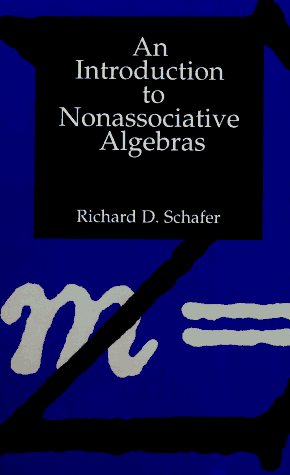
An Introduction to Nonassociative Algebras
by Richard D. Schafer
Publisher: Project Gutenberg 2008
ISBN/ASIN: 0486688135
Number of pages: 81
Description:
Concise study presents in a short space some of the important ideas and results in the theory of nonassociative algebras, with particular emphasis on alternative and (commutative) Jordan algebras. Written as an introduction for graduate students and other mathematicians meeting the subject for the first time.
Download or read it online for free here:
Download link
(PDF, TeX)
Similar books
 Lie Algebras
by Shlomo Sternberg
The Campbell Baker Hausdorff formula, sl(2) and its representations, classical simple algebras, Engel-Lie-Cartan-Weyl, conjugacy of Cartan subalgebras, simple finite dimensional algebras, cyclic highest weight modules, Serre’s theorem, and more.
(18660 views)
 The Octonions
by John C. Baez - University of California
The octonions are the largest of the four normed division algebras. The author describes them and their relation to Clifford algebras and spinors, Bott periodicity, projective and Lorentzian geometry, Jordan algebras, and the exceptional Lie groups.
(20101 views)
 Universal Algebra for Computer Science
by Eric G. Wagner - Wagner Mathematics
A text on universal algebra with a strong emphasis on applications and examples from computer science. The text introduces signatures, algebras, homomorphisms, initial algebras, free algebras, and illustrates them with interactive applications.
(16563 views)
 A Treatise on the Theory of Invariants
by Oliver E. Glenn - Project Gutenberg
The object of this book is to present in a volume of medium size the fundamental principles and processes and a few of the multitudinous applications of invariant theory, with emphasis upon both the nonsymbolical and the symbolical method.
(12001 views)