
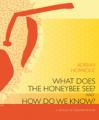
What does the honeybee see? And how do we know?
by Adrian Horridge
Publisher: ANU E Press 2009
ISBN-13: 9781921536984
Description:
This book is the only account of what the bee, as an example of an insect, actually detects with its eyes. The author sets out the history of how bee vision came to be understood, with an account of a century of neglect of old experimental results, errors of interpretation, sharp disagreements, and failures of the scientific method. The erratic path to understanding makes interesting reading for anyone with an analytical mind who thinks about the methods of science or the engineering of seeing machines.
Download or read it online for free here:
Download link
(6.7MB, PDF)
Similar books
 Advances in Stereo Vision
by Jose R.A. Torreao - InTech
In this small book the authors have attempted to present a limited but relevant sample of the work being carried out in stereo vision, covering significant aspects both from the applied and from the theoretical standpoints.
(9810 views)
 Robot Vision
by Ales Ude - InTech
The purpose of robot vision is to enable robots to perceive the external world in order to perform a large range of tasks. This book presents a snapshot of the work in robot vision that is currently going on in different parts of the world.
(12169 views)
 Computer Vision Metrics: Survey, Taxonomy, and Analysis
by Scott Krig - Springer
Provides an extensive survey of over 100 machine vision methods, with a detailed taxonomy for local, regional and global features. It provides background to develop intuition about why interest point detectors and feature descriptors actually work.
(9755 views)
 Modern Robotics with OpenCV
by Widodo Budiharto - Science Publishing Group
This book is written to provide an introduction to intelligent robotics using OpenCV. It is intended for a first course in robot vision and covers modeling and implementation of intelligent robot. Written for student and hobbyist.
(8615 views)