
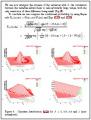
Introduction to the theory of stochastic processes and Brownian motion problems
by J. L. Garcia-Palacios
Publisher: arXiv 2007
Number of pages: 104
Description:
Contents: Historical introduction; Stochastic variables; Stochastic processes and Markov processes; The master equation: Kramers–Moyal expansion and Fokker–Planck equation; The Langevin equation; Linear response theory, dynamical susceptibilities, and relaxation times (Kramers’ theory); Methods for solving Langevin and Fokker–Planck equations; Derivation of Langevin equations in the bath-of-oscillators formalism.
Download or read it online for free here:
Download link
(1.2MB, PDF)
Similar books
 Statistical Physics of Fields
by Mehran Kardar - MIT
Topics: The hydrodynamic limit and classical field theories; Phase transitions and broken symmetries: universality, correlation functions, and scaling theory; The renormalization approach to collective phenomena; Dynamic critical behavior; etc.
(9590 views)
 Operator Algebras and Quantum Statistical Mechanics
by Ola Bratteli, Derek W. Robinson - Springer
These two volumes present the theory of operator algebras with applications to quantum statistical mechanics. The authors' approach to the operator theory is to a large extent governed by the dictates of the physical applications.
(18564 views)
 Lectures on Noise Sensitivity and Percolation
by Christophe Garban, Jeffrey E. Steif - arXiv
The goal of this set of lectures is to combine two seemingly unrelated topics: (1) The study of Boolean functions, a field particularly active in computer science; (2) Some models in statistical physics, mostly percolation.
(12524 views)
 Elements of Phase Transitions and Critical Phenomena
by Hidetoshi Nishimori, Gerardo Ortiz - Oxford University Press
This book provides an introductory account on the theory of phase transitions and critical phenomena, a subject now recognized to be indispensable for students and researchers from many fields of physics and related disciplines.
(1081 views)