
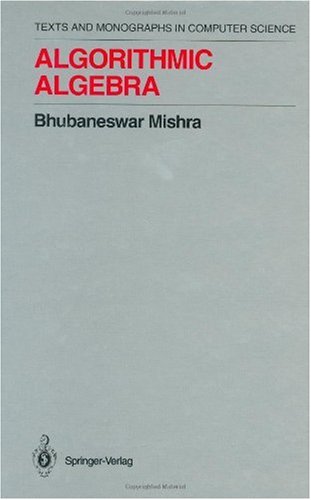
Algorithmic Algebra
by Bhubaneswar Mishra
Publisher: Courant Institute of Mathematical Sciences 1993
ISBN/ASIN: 0387940901
ISBN-13: 9780387940908
Number of pages: 425
Description:
Algorithmic Algebra studies some of the main algorithmic tools of computer algebra, covering such topics as Gröbner bases, characteristic sets, resultants and semialgebraic sets. The main purpose of the book is to acquaint advanced undergraduate and graduate students in computer science, engineering and mathematics with the algorithmic ideas in computer algebra so that they could do research in computational algebra or understand the algorithms underlying many popular symbolic computational systems.
Download or read it online for free here:
Download link
(2.3MB, PDF)
Similar books
 Isabelle/HOL: A Proof Assistant for Higher-Order Logic
by T. Nipkow, L.C. Paulson, M. Wenzel - Springer
This book is a self-contained introduction to interactive proof in higher-order logic, using the proof assistant Isabelle. It is a tutorial for potential users. The book has three parts: Elementary Techniques; Logic and Sets; Advanced Material.
(18451 views)
 Art Gallery Theorems and Algorithms
by Joseph O'Rourke - Oxford University Press
Art gallery theorems and algorithms are so called because they relate to problems involving the visibility of geometrical shapes and their internal surfaces. This book explores generalizations and specializations in these areas.
(21136 views)
 Pictures of Julia and Mandelbrot Sets
- Wikibooks
The purpose of this book is to show how the computer can draw technically perfect pictures of Julia and Mandelbrot sets. All the necessary theory is explained and some words are said about how to put the things into a computer program.
(16095 views)
 Algorithmic Mathematics
by Leonard Soicher, Franco Vivaldi - Queen Mary University of London
This text is a course in mathematical algorithms, intended for second year mathematics students. It introduces the algorithms for computing with integers, polynomials and vector spaces. The course requires no computing experience.
(24394 views)