
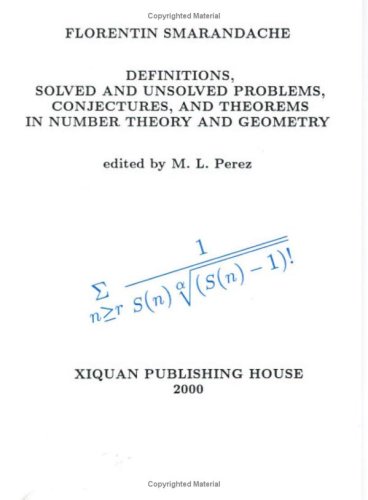
Definitions, Solved and Unsolved Problems, Conjectures, and Theorems in Number Theory and Geometry
by Florentin Smarandache
Publisher: Amer Research Pr 2000
ISBN/ASIN: 187958574X
ISBN-13: 9781879585744
Number of pages: 84
Description:
A collection of definitions, questions, and theorems edited by M. L. Perez, such as Smarandache type conjectures, problems, numerical bases, T-numbers, progressions, series, functions, Non-Euclidean geometries, paradoxes (such as Smarandache Sorites Paradox that our visible world is composed by a totality of invisible particles), linguistic tautologies, Smarandache hypothesis that there is no speed barrier in the universe - which has been extended to SRM-theory.
Download or read it online for free here:
Download link
(2.7MB, PDF)
Similar books
 Stability Analysis via Matrix Functions Method
by A. A. Martynyuk - Bookboon
The monograph presents a generalization of the well-known Lyapunov function method and related concepts to the matrix function case within the framework of systematic stability analysis of dynamical systems (differential equations).
(9157 views)
 Discrete Dynamical Systems
by Arild Wikan - Bookboon
This book covers important topics like stability, hyperbolicity, bifurcation theory and chaos, topics which are essential to understand the behavior of nonlinear discrete dynamical systems. The theory is illuminated by examples and exercises.
(8175 views)
 The Hopf Bifurcation and Its Applications
by J. E. Marsden, M. McCracken - Springer
The goal of these notes is to give a reasonably complete, although not exhaustive, discussion of what is commonly referred to as the Hopf bifurcation with applications to specific problems, including stability calculations.
(13845 views)
 Local Theory of Holomorphic Foliations and Vector Fields
by Julio C. Rebelo, Helena Reis - arXiv
Informal lecture notes intended for graduate students about the standard local theory of holomorphic foliations and vector fields. Though the material presented here is well-known some of the proofs differ slightly from the classical arguments.
(9687 views)